Period press · Common Point, November 1983 · scan pages 10 and 11
The Otari 5050B-II With The Proof Of Performance
View source PDF ↗The Otari 5050B-II With The Proof Of Performance
New Features.
- Transformerless balanced microphone inputs with switchable 20 dB pad and mute.
- Transformerless balanced line inputs and outputs.
- Variable low frequency reproduce equalization (switch defeatable).
- Microprocessor-controlled, real-time counter with Memory Rewind and L.E.D. display.
- Dual frequency oscillator (1 & 10 kHz).
- Front panel record level indicators (185, 250, & 320 nWb/m).
- Front panel equalization indicators (IEC/NAB).
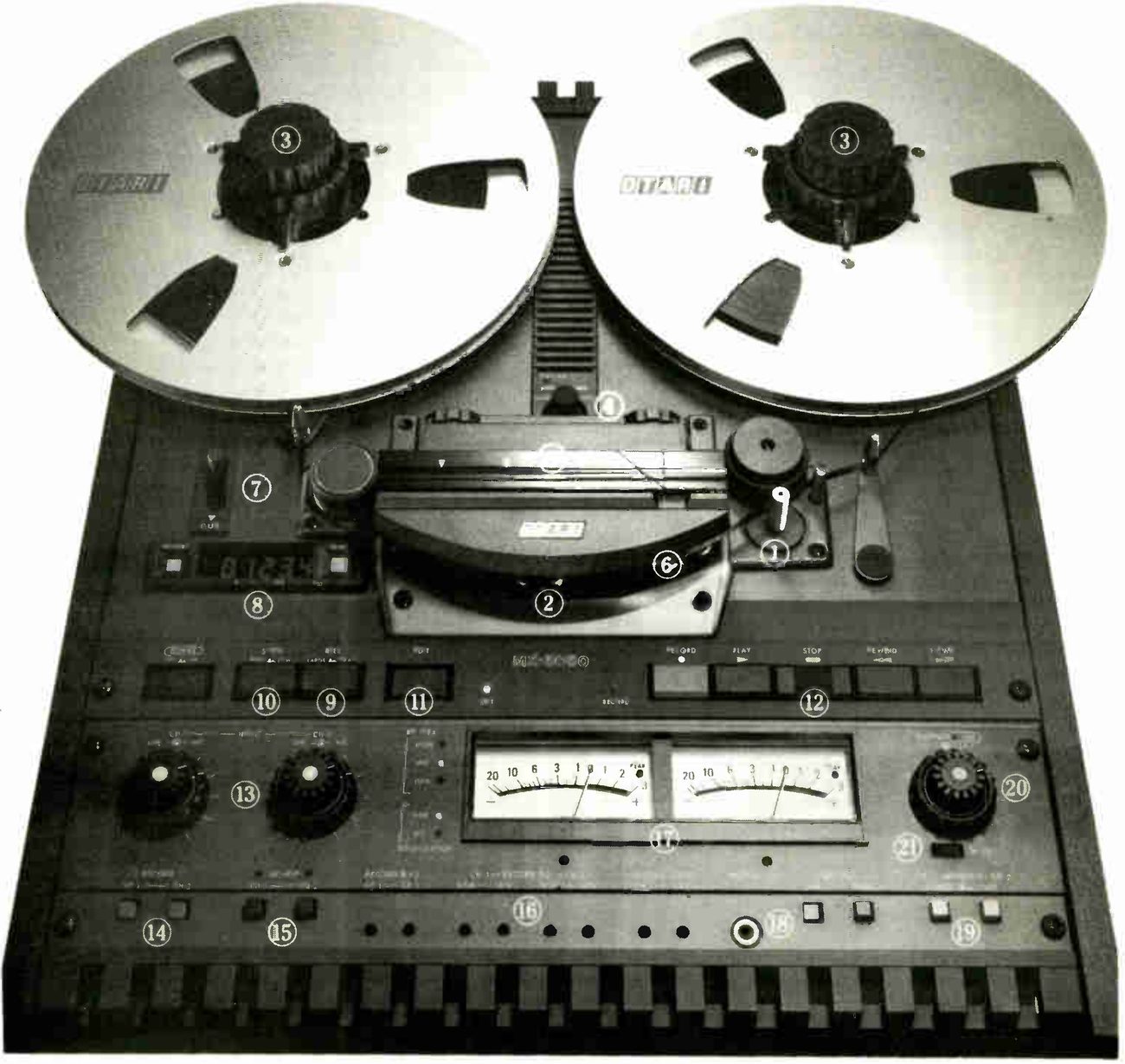 ⤢ zoomThe 5050B-II photographed from above: two ten-inch reels with OTARI on the flanges, the head assembly under its hinged cover, the tape counter to the left of the heads, a row of transport pushbuttons, two VU meters between the input and output level knobs, and a row of switches along the bottom; circled numbers 1 to 21 are printed over the controls.
Based On Technology You Can Trust
5050B-II Features.
- D.C. capstan, servo-controlled.
- Switch selectable 1/4 track or 1/2 track playback head.
- Positive-locking NAB hub adapters.
- Variable speed control (±7%).
- Hinged head cover with integral tape splicing block.
- Plug-in four head design; Permalloy for optimum head life and maximum output.
- Adjustable Cue control (tape lifter defeat).
- Microprocessor-controlled, real-time counter with Memory Rewind and Reset.
- Reel size compensation switch.
- Speed select (chooses high or low speed of internally selected speed pair).
- Dump edit switch (spills tape between capstan and take-up reel).
- Transport controls with full motion-sensing logic.
- Microphone and Line input mixing on each channel.
- Safe/Ready switch for each channel (with L.E.D. indicators).
- Selective Reproduce for overdubbing.
- Front panel record calibration adjustments.
- Lighted V.U. meters with L.E.D. peak indicators.
- Headphone jack.
- Tape or Source monitor select.
- Output level control.
- SRL select switch with L.E.D. indicator (switchable between variable output and Standard Reference Level).
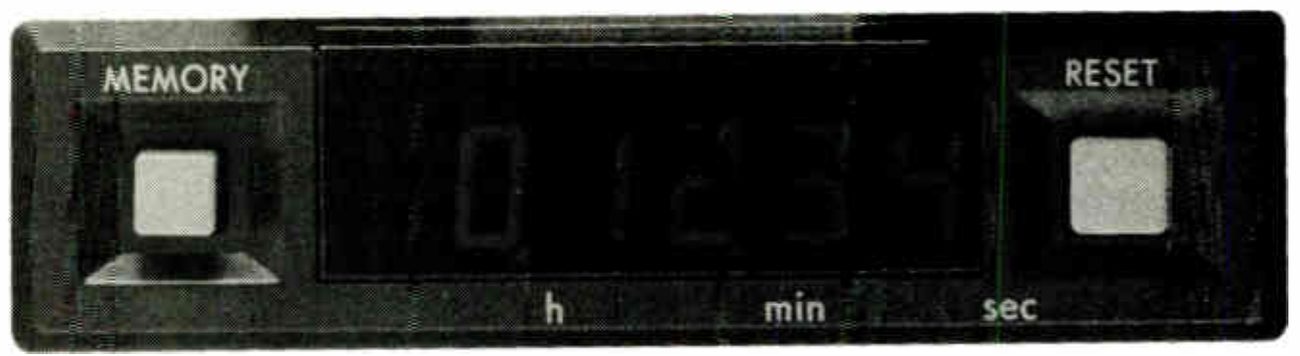 ⤢ zoomThe tape counter panel close up: a MEMORY button on the left, a RESET button on the right, and a dark L.E.D. window between them with digits and the labels h, min and sec beneath.
Tape accurate at all speeds, a microprocessor-controlled real-time counter features a Memory Rewind and L.E.D. display in hours, minutes and seconds.
New! A Feature That Removes The Guesswork.
The new B-II now includes a microprocessor chip that accurately counts elapsed time in hours, minutes and seconds. Tape accurate at all speeds, it has a multi-digit L.E.D. display with both positive and negative domain. This feature is extremely helpful in situations such as spot production where an accurate measure of program time is critical.
When you need to play and repeat a section continuously, we've given you a feature we call Memory Rewind. You'll call it great. With the Memory button depressed, the transport will enter the Stop mode when rewinding past "0.00.00". The Reset button returns the real-time display to "0.00.00" regardless of actual tape location.
The Electronics: New And Improved!
Now, here's where the new B-II leaps ahead of the other guys' "Hi-Fi" heritage.
Concentric Mic/Line Input level controls for each channel permit you to mix on the machine if you wish. For added versatility when using preamplifiers or high output microphones, a rear panel switch inserts a 20 dB pad on each channel.
The microphone inputs are balanced and transformerless to put as little as possible between the sound and the tape. The line inputs and outputs are also balanced and transformerless to achieve the lowest noise figures, highest fidelity and professional flexibility. Optional transformers are available should your application require them.
Next to the input level controls are two large, easy-to-read lighted V.U. meters with peak-responding L.E.D.'s. Factory calibrated to +9dB, a different threshhold may be user adjusted for this important feature. Concentric output level controls are adjacent to the meters. Below these controls is a switch for selection of Standard Reference Level (SRL) or a variable output position. Normally +4 dBm for a balanced 600 ohm line, the output of the B-II may be changed to −10 dBV by a rear panel switch to facilitate the interface with low-level mixers or peripheral equipment.
To optimize performance with tapes which have been recorded at another facility, there's a Ref Flux switch that will give you a choice of three reference fluxivity levels: 185, 250 & 320 nWb/m. (The latter being the IEC and DIN standard). This same flexibility allows you to choose how "hot" a recorded level gets put on tape. Front panel L.E.D. indicators report the selection of the chosen calibration level.
DISTRIBUTED BY ELECTRONIC INDUSTRIES INC. 19 E. IRVING, OSHKOSH, WI 54901 — 800-558-0222 — 414-235-8930