Is it a Mini Pro?
The first-generation MX-5050 — the Mini Pro — is far less common than the B, BII and BIII machines that followed it, and most of what's written online describes those later models. Before you buy parts, download manuals, or follow repair advice, it's worth confirming which machine you actually have.
The markers below are checked against my own deck and against the period documentation. If you want the family tree they sit in, the generation table on the history page is the one-screen version.
The silver backed plate
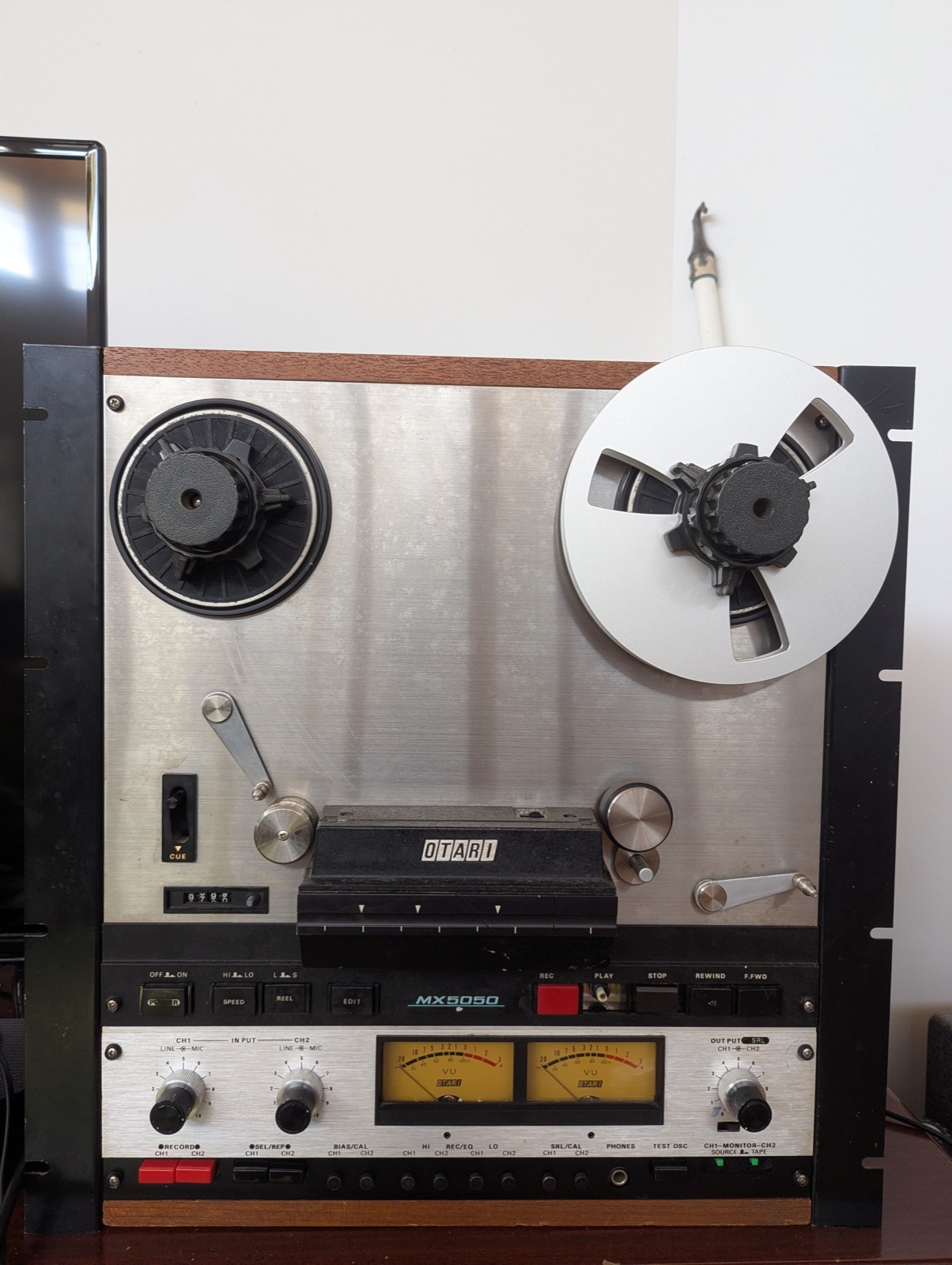 Front of a first-generation MX-5050: silver backed plate behind the knobs and meters, wooden trim, rack-mount brackets
The first dead giveaway: a silver backed plate behind the knobs and level meters, with an outside wooden finish. Mine wears rack-mounting brackets instead of the factory wood side panels, but the silver plate is unmistakable.
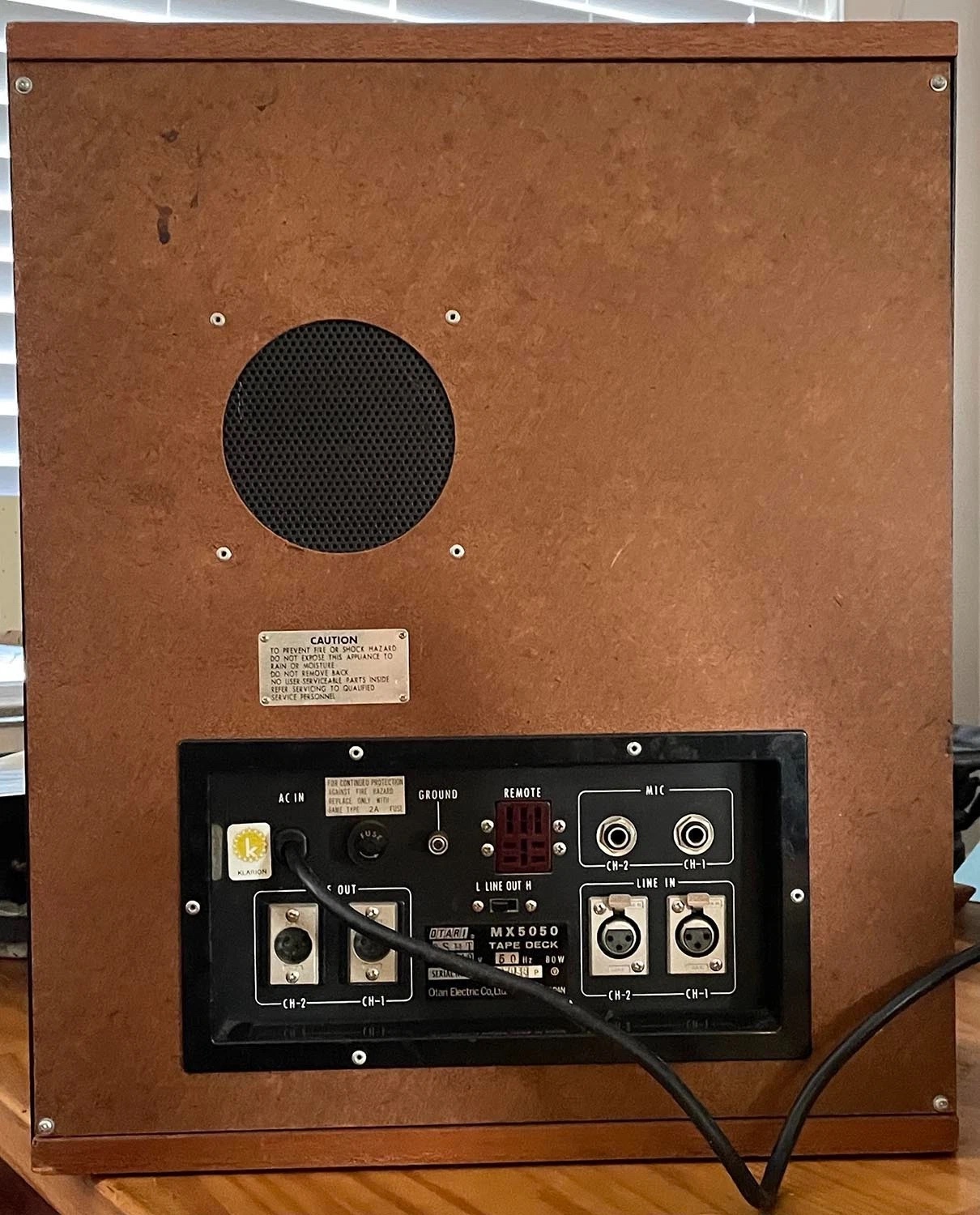 The back of my deck: the factory wood case, with the rear jack panel recessed into it
The wood isn't just trim — the whole case is timber: the standard cabinet was a factory walnut finish, with a portable case and a rack kit as the alternatives. Here's mine from the back, with the jack panel recessed into the case. The yellow Klarion sticker beside the AC inlet is a period marker of its own — Klarion Enterprises of South Melbourne was the Australian distributor named in Electronics Australia's June 1976 review.
The face badge
Start with what the badge cannot tell you, because this is the pitfall
that sends people down the wrong path: the face badge does not carry the
model suffix — on any generation. Photographs of B, BII, BIII, MKIII and
MKIV machines, each checked against its own rear plate, all show the same
thing: a bare MX-5050 on the transport panel. A deck whose rear plate
reads MX5050 BII2 or MX5050 MKIII-2 still shows you nothing but
"MX-5050" from the front.
So the reasoning you'll see in forum threads and sellers' listings — "it doesn't say B on the front, so it's a Mark I" — rests on a marker that doesn't exist. A bare badge is not evidence of anything. The suffix lives on the rear plate.
What the badge can do is two things. The first is the best single marker on the whole machine — because on some first-generation decks, Otari printed the nickname straight onto the front:
 The badge on a first-generation MX-5050: MX5050 in white italic script above a blue rule, with MINI PRO in blue outlined capitals directly beneath it
Badge detail from a wood-cased 1975 machine photographed by Ottermel — Tapeheads.net.
MINI PRO, in blue outlined capitals, silk-screened directly beneath the logotype. No later machine wears it. If you find that on a faceplate, you are looking at a first-generation deck and the identification is over — it is the one badge marking that settles the question by itself. It is also the proof that "Mini Pro" was never collector slang: Otari put the name on the machine. The history page traces the same name through the trade press and Otari's own advertising.
The same second line shows on the US-market 2SH photographed in Audio's April 1976 review — too coarse in the halftone to read, but plainly there under the badge in both of the review's photos.
The catch is that not every first-generation machine has it. Mine doesn't — just the bare underlined logotype — and neither do several other documented first-gens, including a DC-servo 2SHTD. So the rule runs one way only: MINI PRO under the logotype is proof of a first-generation machine; its absence proves nothing at all. What separates the two styles — production date, market, or a running change on the line — is still an open question. If your machine wears the MINI PRO badge, a photo and the serial number would be gratefully received; enough of them and the pattern would fall out.
The second thing the badge tells you is the era, through how it's made rather than what it says. The first generation's logotype is italic script, underlined, as in the photo above. The BII/MKIII-era machines print an upright, outlined MX-5050 centred on the transport panel. By the BIII/MKIV era it is an embossed silver plaque at the right-hand end of the panel. Same seven characters every time; three different pieces of industrial design. (The MKIII and MKIV are not later generations than the BII and BIII, incidentally — they are their desk-top siblings. That story is the wider family.)
The record buttons: a test you can run on a photograph
This one is for buying. Most listings show you the front of the machine and nothing else — no rear plate, no inside. There is a marker in those photos that will not tell you it's a Mini Pro, but will rule out every machine from the BII onward, in one glance.
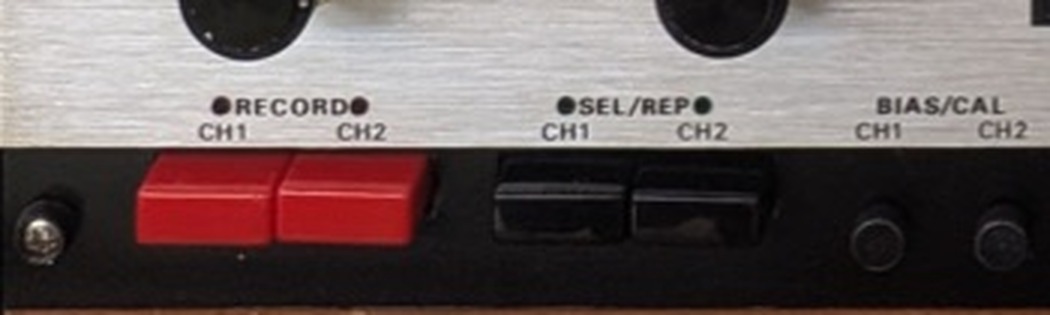 The record-ready buttons on a first-generation deck: the two red RECORD CH1 and CH2 caps butt directly against each other, forming a single continuous red bar, and the black SEL/REP pair beside them does the same
First, be sure you are looking at the right red buttons. There are two sets. The ones that matter are the record-ready pair on the electronics panel — labelled RECORD CH1 / CH2, down among the level knobs, as in the photo above. The other red button, up in the transport row beside PLAY and STOP, is the REC key, and it is no help at all: measured across the generations, a first-gen, a B, a BII and a MKIII all wear much the same wide red key. (It does change at the BIII and MKIV — going square, with a symbol instead of a word — which is the opposite direction to the record-ready buttons, and a fine way to confuse yourself.)
Now: do the two red RECORD-READY buttons touch?
- Touching — butted against each other into one continuous red bar, each cap about half again as wide as it is tall — means an MX-5050 (first generation) or an MX-5050B. Everything before the BII.
- Separated — a gap of roughly one and a half button-widths between two square caps — means a BII, BIII, MKIII or MKIV. Otari redesigned the whole switch family at the BII, and the black SEL/REP pair beside them changed in exactly the same way, so it doubles as a cross-check.
Measured across eleven machines — eight of them confirmed by their own rear plates — the gap was zero on every first-generation and B machine, and one-and-a-half to two button-widths on every BII and later machine, with no overlap. Adjacency is the right thing to measure, too: a gap and a width are both horizontal lengths on the same panel, so their ratio survives a photograph taken at an angle, where an aspect-ratio measurement would be distorted by the perspective.
Be clear about what this buys you, though. It is a negative test. Square, separated buttons rule the Mark I out. Touching, rectangular buttons narrow your machine to first generation or B — and then you still have to settle it with the silver plate and the rear plate.
The model reference — read the rear plate
Since the face won't tell you, this is where identification actually
happens. Every MX-5050 states its model on the rear jack panel, and the
first generation's references are 2S, 4S, 2SD and 4SD — with the US
catalog's 2SH, 4SH and 2SH-2, and my own 2SHT, among them. A later machine's
plate spells its generation out in full: MX5050 BII2, MX5050 MKIII-2,
MX5050 MKIV-2. Find a B, a BII, a BIII or a MARK number there and you have
a later machine.
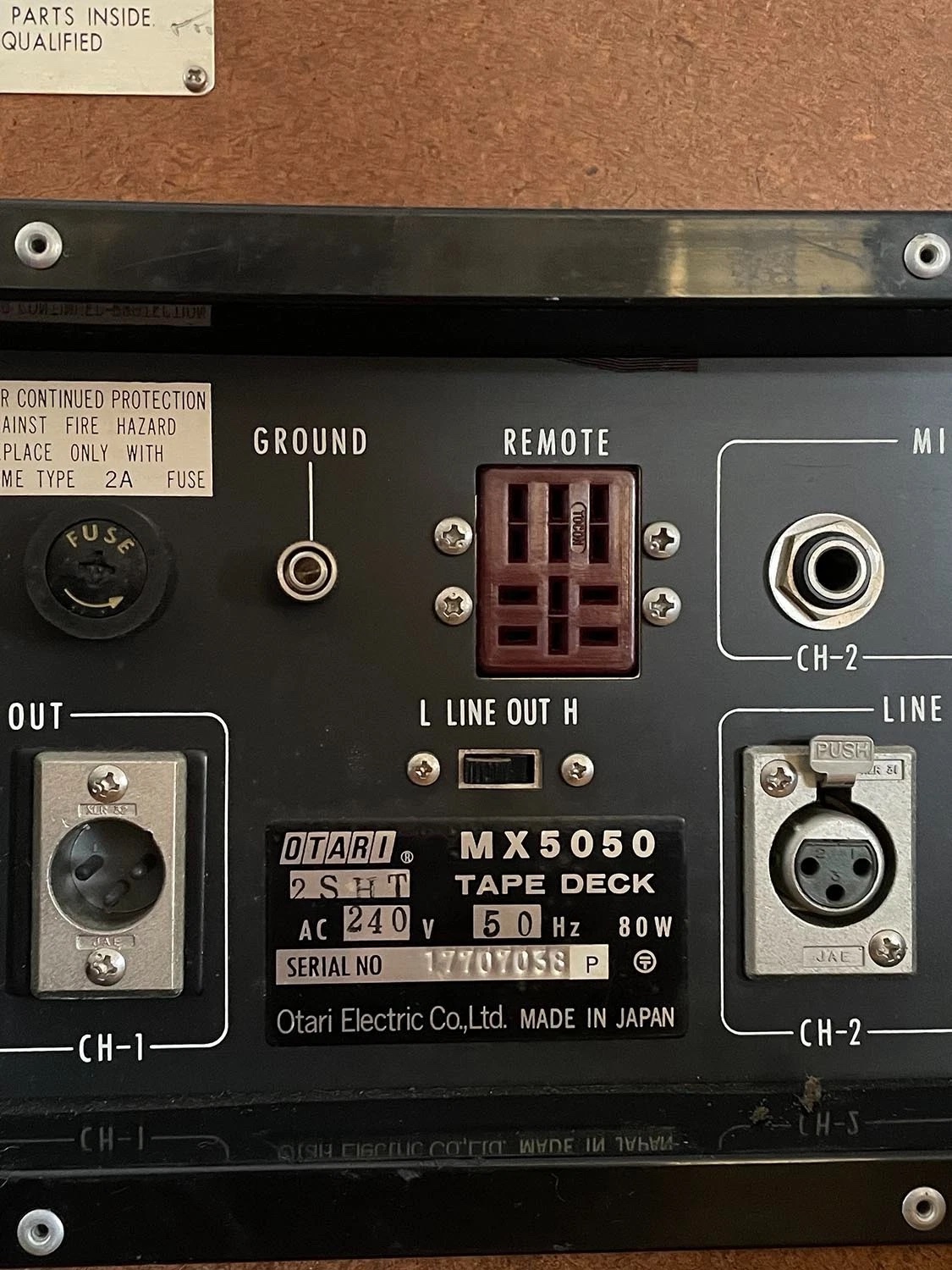 The model plate on my deck's rear jack panel: OTARI MX5050 TAPE DECK, model 2SHT, AC 240 V 50 Hz 80 W, serial no. 17707038 — Otari Electric Co., Ltd., made in Japan
The serial number dates the machine
The plate gives you more than the model. The second and third digits of the
serial number are the year of manufacture. Mine reads 17707038 —
1977 — and the TOWA capacitors inside are date-stamped 1977, which is a
second, independent witness on the same deck.
I did not originate this rule: it comes from a single forum post, offered without evidence, and on its own that is not enough to publish. So I tested it against every MX-5050 I could find whose generation is settled by its own rear plate, never by the serial:
| Machine (identified from its rear plate) | Serial | Digits 2–3 | Implied year | Consistent? |
|---|---|---|---|---|
| First-generation 2SHT (mine) | 17707038 | 77 | 1977 | ✓ first gen ran 1974–77 — and the caps agree |
| MX-5050 BII-2 | 18690154 | 86 | 1986 | ✓ BII era |
| MX-5050 MKIII-2 | 18630546 | 86 | 1986 | ✓ MKIII from 1983 |
| MX-5050 MKIV-2 | 19452149 | 94 | 1994 | ✓ MKIV from ~1990 |
Four machines, four generations, four years that each land inside the right
production window — and rising in step with the generations. That is enough to
use, with two honest caveats: the sample is four, and what the leading 1 and
the trailing digits mean is anyone's guess.
If you send me a serial with a photo, you extend that table — and if your deck wears the MINI PRO badge, you also help settle when Otari stopped printing it.
Mine reads 2SHT, a designation Electronics Australia decoded when it reviewed this exact model in June 1976: 15 and 7.5 in/s tape speeds — as built; mine now runs 7.5 and 3¾, because a previous owner fitted the low-speed motor pulley and belt and left the plate alone (see the log) — with a four-head assembly — erase, ½-track record, ½-track playback and ¼-track playback, behind a playback changeover switch. And critically: no B and no MARK number anywhere on the plate. Above it sits the empty remote socket, as the deck arrived — the one the dummy plug now lives in.
The AC capstan motor
On a standard first-generation machine, the capstan motor is powered by AC — a hysteresis-synchronous motor that locks to your mains frequency. (DC-servo varispeed first-gens existed too — the 2SD/4SD models documented in the maintenance manual, and the US catalog's 2SH-2 option — so "AC capstan" and "first gen" aren't perfectly interchangeable.)
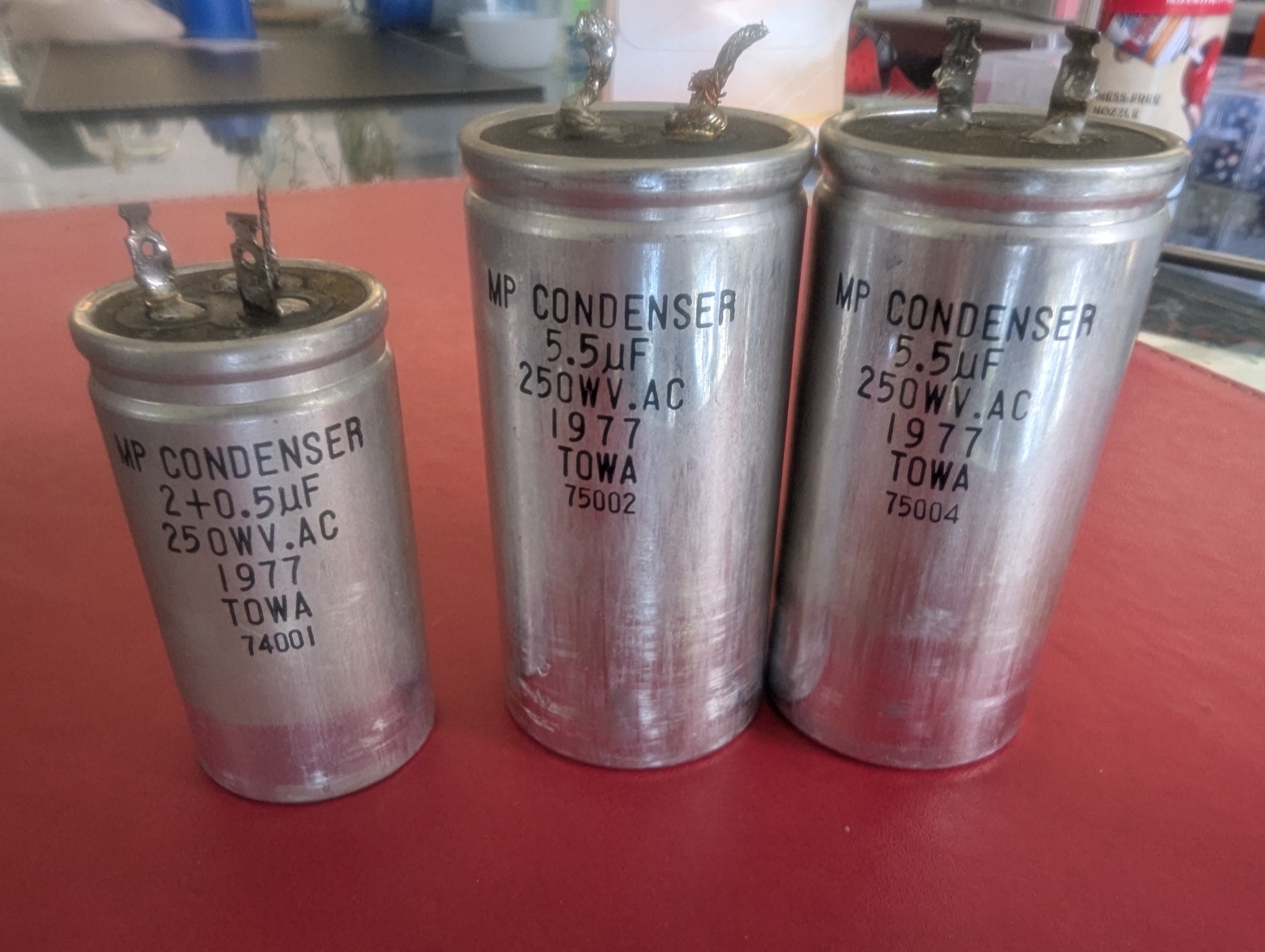 Three AC motor-run capacitors from the MX-5050: TOWA MP condensers, 250 WV.AC, dated 1977. The smaller 2+0.5 µF (left) is the capstan motor's run cap — it rules out the DC-servo direct-drive machines, though the plain-B 2H/2L/4L kept an AC capstan too. The two 5.5 µF serve the reel motors, which stayed AC induction on every later model, so reel-motor caps alone prove nothing.
You'll find the AC motor-run cap near it — mine carried TOWA "MP condenser" cans: a 2 + 0.5 µF for the capstan motor and a pair of 5.5 µF for the reel motors, all rated 250 WV.AC and dated 1977. Be precise about what the capstan cap tells you: a DC-servo direct-drive capstan has no run cap, so finding one rules out every BII and BIII and the D-suffix B models — but the plain MX-5050B 2H, 2L and 4L kept an AC synchronous capstan. Treat it as supporting evidence next to the silver plate and the model reference, not as proof on its own. What replacing these involves — including how to make a 5.5 µF that nobody sells any more — is in Re-capping the motor run caps.
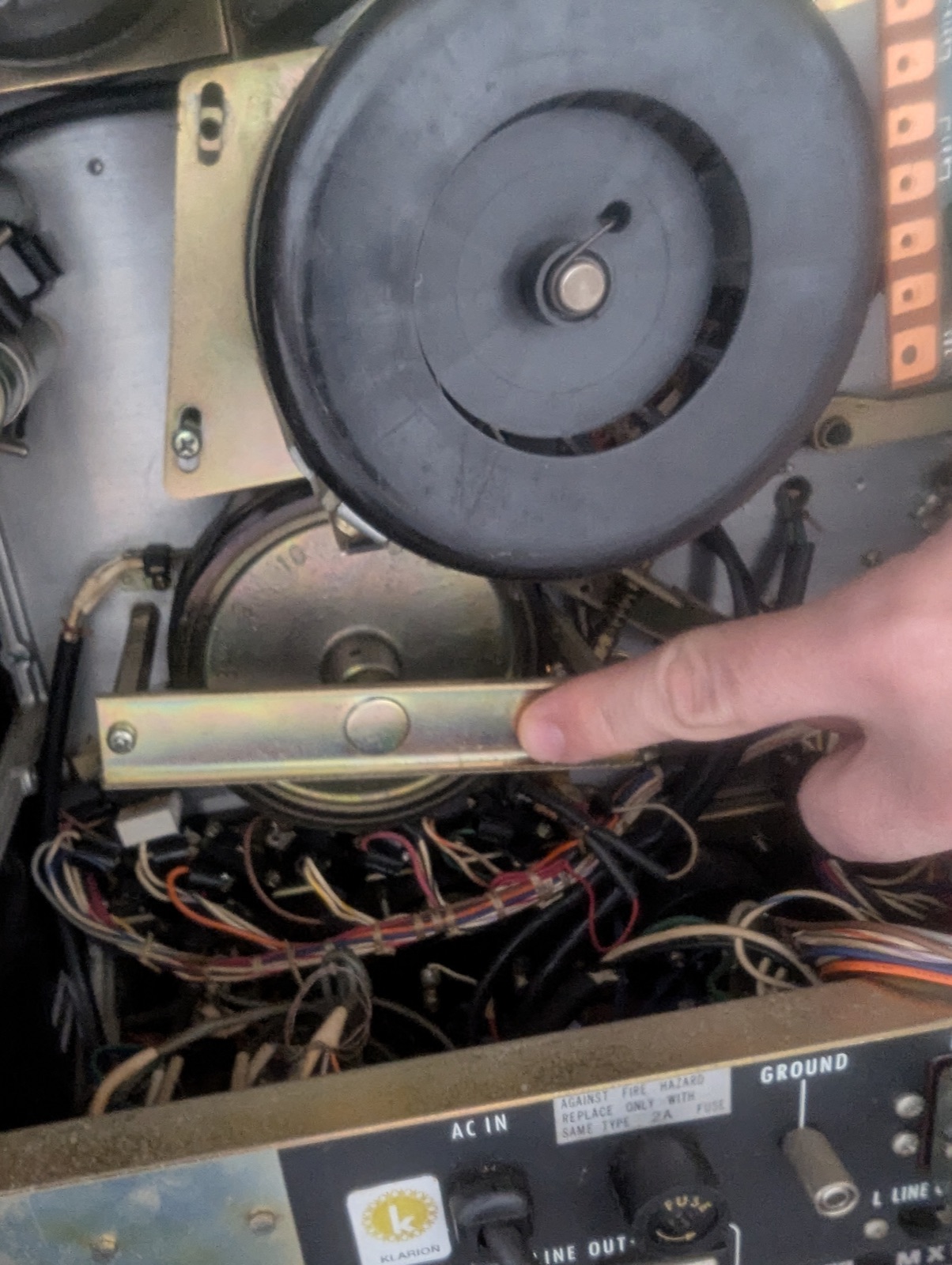 The capstan flywheel inside the MX-5050 transport
You'll also find that the capstan is belt-driven with a flywheel — the motor doesn't turn the capstan shaft directly, which rules out the direct-drive DC-servo generations.
The P-12 speed board
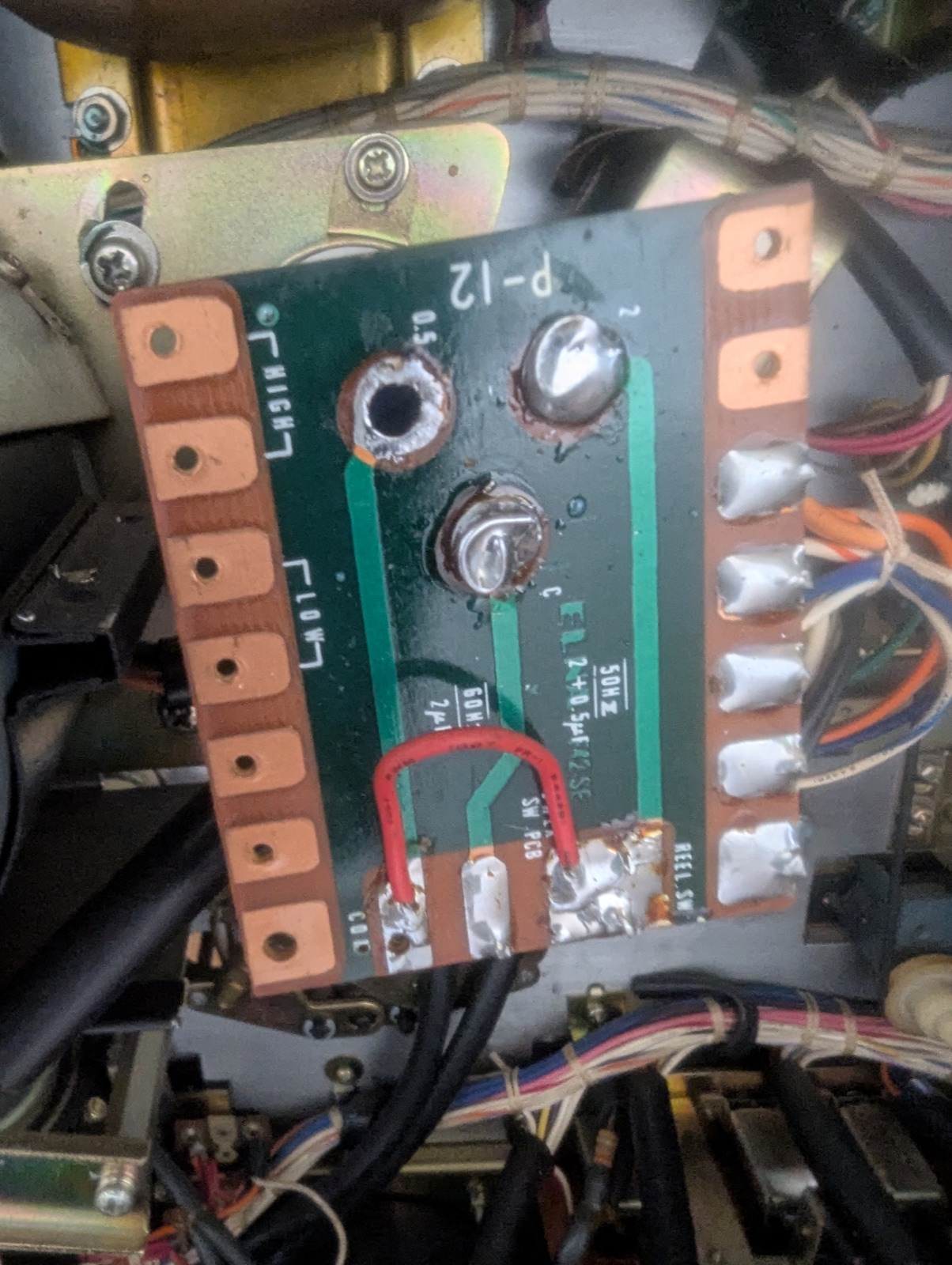 P-12 speed board with different capacitor values marked for 50 Hz and 60 Hz mains. Note: this board is already re-capped — I fitted a single 2.5 µF motor-run cap, which is all I need at 50 Hz, so only two legs are wired in. On an unrestored unit you'd see all three contacts coming through.
Supporting evidence if you're inside the machine anyway: the P-12 speed board is marked with different capacitor values for 50 Hz and 60 Hz mains — a distinction that only matters to a mains-synchronous AC motor.
If it doesn't match
If your machine doesn't show these markers, it's one of the later models — and much of this site won't apply to it, starting with the maintenance manual, which documents the 2S/4S/2SD/4SD transport and no other.
That is not a dead end, though. Work out which later machine you have from its rear plate, then read across the generation table: a plain-B 2H, 2L or 4L still has the AC synchronous capstan and the belt, so a fair amount here still applies to it. If the plate carries a MARK number, start with the wider family — those machines are the B series' desk-top siblings, and a MKIII-2 shares its heads and audio board with a BII.
If it isn't a Mini Pro
Each sibling has a reference page of its own, with what this site holds and what it wants for it. Three tells apiece:
- Mark II — two boxes: transport and electronics separated; a DC-servo capstan fitted as standard; the MKII designation on the rear plate, never the face.
- MX-5050B — darker trim; "MX-5050B" with an H/L suffix on the rear plate; a belted capstan flywheel on the 2H/2L/4L, none on the D-suffix machines.
- MX-5050BII — one chassis, not the Mark II's two; a digital LED tape timer with a memory stop; three speeds, factory-set to 15 and 7½ and convertible to 7½ and 3¾.
- MX-5050-8 / 8D — half-inch tape and an eight-channel head block; DC-servo capstan as standard.
- QX / QXD / QXHD — quarter-inch tape with a four-channel head block; DC-servo capstan.
The family hub puts them all on one generation table.