BQ-II Instruction and Maintenance Manual — Digital Edition · Part 1 · PDF pages 9-16
General Information
The MX-5050 BQII Recorder is a professional quality two-speed audio tape recorder/reproducer, designed for optimum performance and long life.
It accommodates a 1/4-Inch wide tape and two 7 1/2 ips (19.05 cm/sec.) and 15 ips (38.1 cm/sec.) tape speeds.
1 -1 SYSTEM DESCRIPTION↑ TOP
Among the many professional features of the MX-5050 BQ:II are: selective reproduction (SEL/REP), automatic motion sensing control by a proprietary microprocessor, an edit control that permits tape spilling, dynamic braking, an electronic tape timer, an adjustable cueing control for audible monitoring in fast forward and rewind, a dual frequency built-in test and cue-tone oscillator, adjustable record bias, equalization and level controls, XLR type connectors for input and output lines, separate line and microphone input level controls for each channel, a VU meter with a peak indicator for each channel, selecting switches for input and output levels, and a memory stop for automatically stopping the tape at a desired position except in record mode.
1-1-(1) TAPE TRANSPORT↑ TOP
All components of the tape transport system are mounted on a rigid aluminum base for stability. The transport design incorporates two 6-pole induction motors for the tape reels and a de servo motor (Direct drive) for the capstan. A pitch controls available to adjust the control range of the tape speed within ±7% of the nominal speed for sound application.
The transport accommodates tape reels of 10 1/2 inches, 8 inches, 7 inches, and 5 inches in diameter in NAB or EIA hub configurations. In addition to the editing controls, a tape-splicing block (Figure 3-3) mounted on the head cover holds the tape for easy editing, cutting, and applying splicing tape. Momentary contact pushbutton switches on the transport are used to select operational modes: record, play, stop, rewind, fast forward, and edit. These modes except edit mode can be controlled from a remote location by using an optional remote control unit.
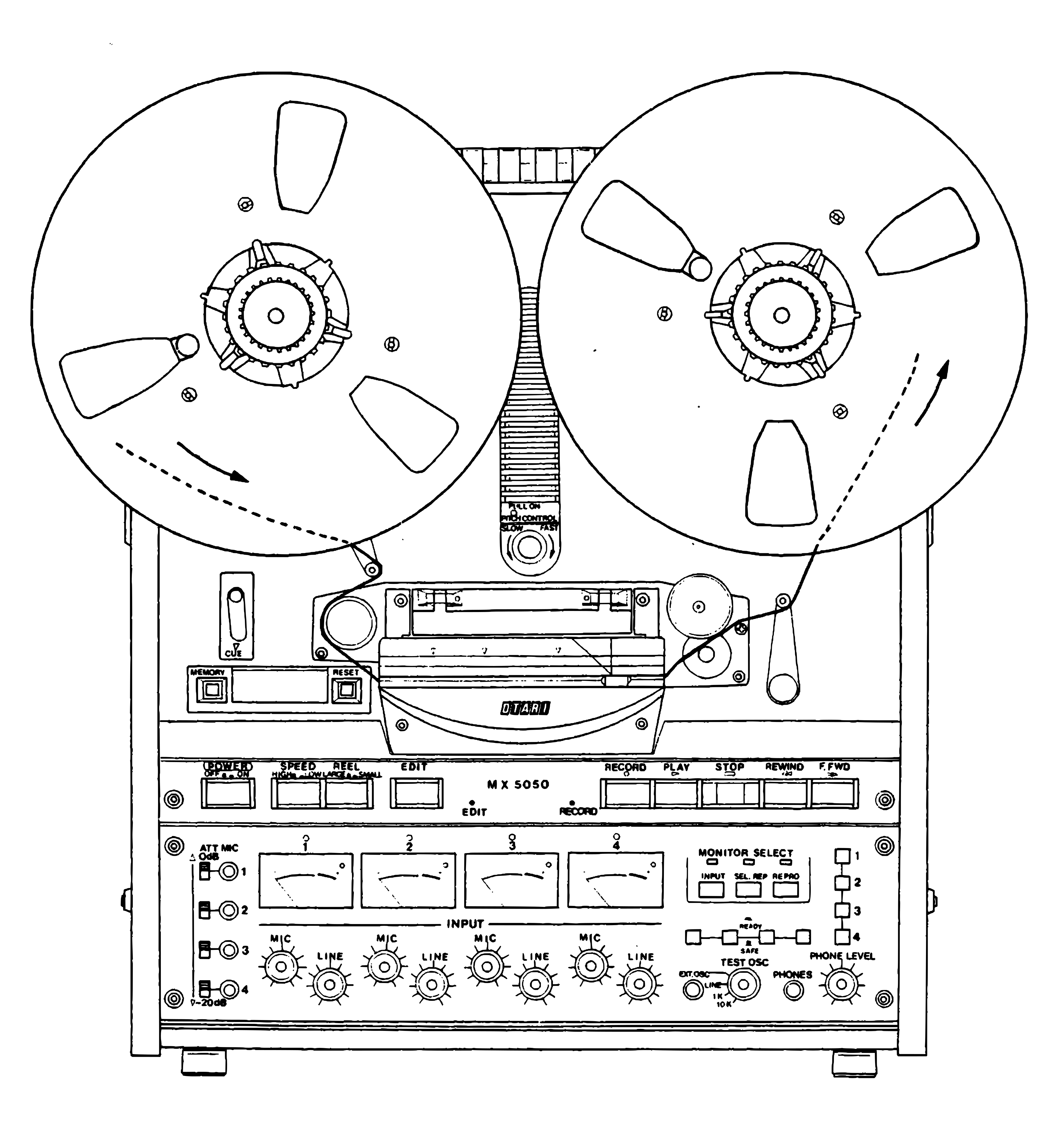 ⤢ zoomFront-view line drawing of the MX-5050 BQII: two 10½-inch reels above the head assembly, the row of transport pushbuttons, and an amplifier panel with four VU meters, MIC and LINE input knobs, monitor-select and test-oscillator controls.
Figure 1-1 MX-5050 BQII Major components
1-1-(2) RECORD/REPRODUCE ELECTRONICS↑ TOP
FEATURES
(1) The RECORD/REPRODUCE amplifier unit is interconnected to the transport unit by just the connectors, and the internal components and the adjustment controls are accessible from the front to facilitate maintenance.
(2) Available sound applications are a SEL/REP. function for overdubbing: SOUND WITH SOUND, SOUND ON SOUND, etc, carried out by the PUNCH-IN and PUNCH-OUT functions of the transport control.
(3) Both input and output level select switches are provided on the printed circuit board to select either input or output level.
(4) For optimum performance corresponding to the tape used, the Record bias, level, and equalizer controls can be accurately adjusted from the adjusting panel
(5) Low frequency compensation controls are provided for possible accurate allignment of low frequency characteristics to meet the tape to be used.
1-2 STANDARD ACCESSORIES↑ TOP
The MX-5050 BQII is supplied with the standard accessories listed in Table 1-1.
Table 1-1 Standard Accessories
| Description | Quantity | Otari Part Number |
|---|---|---|
| Power Cord | 1 | PZ4D003 |
| NAB Hub Reel Hold Down Knob (10 1/2") | 2 | KWOHA |
| NAB Empty Reel (10 1/2") | 1 | ZA-51A |
| Reel Adjusting Disc (Shim)* | 2 | KWOC005 |
| Instruction & Maintenance Manual | 1 | 053-031 |
* The Reel Adjusting Disc (Shim) is placed between a metal reel and the reel table to compensate for the difference in thickness between metal reels and plastic reels.
1-3 OPTIONAL ACCESSORIES↑ TOP
Available optional accessories are listed in Table 1-2.
Table 1-2 Optional Accessories
| Description | Otari Part Number |
|---|---|
| Remote Control Unit | CB-102 |
| EIA Hub Reel Hold Down Knob [7"J | ZA-52Y |
| DIN Hub Reel Hold Down Knob Assembly | ZA-52Z |
| Cleaning Kit | ZA-51B |
| Tape Deck Pedestal | ZA-52L |
| Extension Board Ashley | PB-77X |
1-4 SPECIFICATIONS↑ TOP
The specifications of the MX-5050 BQII are as listed in Table 1-3.
Table 1-3 Specifications
| Tape Width and Tracks: | 1/4 Inch (6.3 mm) tape 4 tracks (0.037 inch or 0.94 mm track width) |
| Tape Speeds: | 7 1/2 and 15 ips (19.05 and 38.1cm/sec.) Maximum deviation: ±0.2% measured with 1.5 mil (0.038 mm) tape |
| Reel Sizes: | 5, 7 or 10 1/2 Inch plastic or metal, EIA or NAB. |
| Heads: | Four head stacks: 1/4" erase x 2 ( 1 -3, 2-4CH) 1/4" record 1/4" reproduce |
| Motors: Capstan: | DC servo controlled motor (Pitch control range ±7%) |
| Reels: | Two torque motors |
| Rewind Time: | Approximately 90 seconds for 2,500 ft (760 m) NAB reel |
| Operating Position: | Vertical or at angle |
| Power Requirements: | 100, 117, 220, 240 volts, 50 or 60 Hz, single phase AC. |
| Power Consumption | 100 watts |
| Operating Environment: | 40° to 104°F (5° to 40°C) 20% to 80% Relative Humidity |
| Storage Environment: | -5° to 113°F (-20° to 45°C) |
| Dimensions and Weight: | Dimensions: 438 mm width, 269 mm depth, 527 mm height. 17.3 " width, 10.6" depth, 20.8" height Weight: 27 kg, 60 lbs. |
| Mounting: | Dark leatherette-finished cabinet. |
| Remote Control Unit: | An optional remote control unit is used to control the record, play, stop, rewind, and fast forward modes. (CB-102) |
| Connectors: | LINE INPUT, LINE OUTPUT: standard three-pin XLR. MICROPHONE, EXT OSC: standard single-conductor phone jack PHONES: standard two-conductor phone jack |
| Inputs: LINE: | Minimum -6 or -18 dBm switchable, unbalanced 50 kohm. |
| MICROPHONE: | Minimum -70 dBm, unbalanced. Applicable microphone impedance: 150 ohm to 1 kohm. The microphone attenuator switch may be set to the 0 or -20 dB position depending on the circumstances. |
| EXT OSC: | Minimum -18 dBm, unbalanced 10 kohm. Outputs: LINE: +4 or -8 dBm switchable, unbalanced. Load impedance: more than 600 ohm. Maximum line output level: +21 dBm with 600 ohm load |
| Headphone Jack: | -19 dBm with an 8 ohm load Load impedance: 8 ohm or greater |
| Equalization: | NAB or IEC for 7 1/2 and 15 ips. |
| Frequency Response: | REC/PLAY 15 ips: 30Hz to 20kHz ±2 dB 7 1/2 ips: 20Hz to 18 kHz ±2 dB SEL/REP 15 ips: 50Hz to 18 kHz ±3 dB 7 1/2 ips: 30Hz to 12 kHz ±3 dB Specifications refer to a 1 kHz reference when recorded on 3M #226. |
Signal to noise ratio:
| Tape speed\EQ. | NAB | IEC | ||
|---|---|---|---|---|
| Weighted | Unweighted | Weighted | Unweighted | |
| 15 ips | 69 dB | 66 dB | 69 dB | 66 dB |
| 7 1/2 ips | 69 dB | 66 dB | 69 dB | 66 dB |
| Crosstalk: | greater than 55 dB |
| Wow and Flutter: | NAB weighted: 15 ips: less than 0.06% 7 1/2 ips: less than 0.08% |
| Distortion: | less than 0.5% at 1 kHz at 250 nWb/m. |
| Erase Efficiency: | greater than 70 dB. |
| Test Oscillator Frequency: | Nominal 1 kHz and 10 kHz. |
| Bias and Erase Frequency: | 200 kHz |
| Peak indicator: | Trigger level: 1040 nWb/m (15 dB above AMPEX operating level) recorded flux level. |
Notes:
-
Signal to noise ratio is measured with respect to a recorded level of 1,040 nWb/m to biased tape noise when using 3M #226, magnetic tape.
Unweighted: Using a 30 Hz to 18 kHz RC filter to eliminate noise outside the audio spectrum
Weighted: Using an NAB or ASA "A" weighting filter and a 1 kHz reference -
Main schematic diagrams are at the end of this manual.
-
OTARI reserves the right to change specifications without notice and/or obligation.