Sales brochure 1978 · Part 1 · scan pages 1
View source PDF ↗Cover & Introduction
MX-5050 COMPACT PROFESSIONAL RECORDER↑ TOP
ONE AND TWO CHANNEL VERSIONS
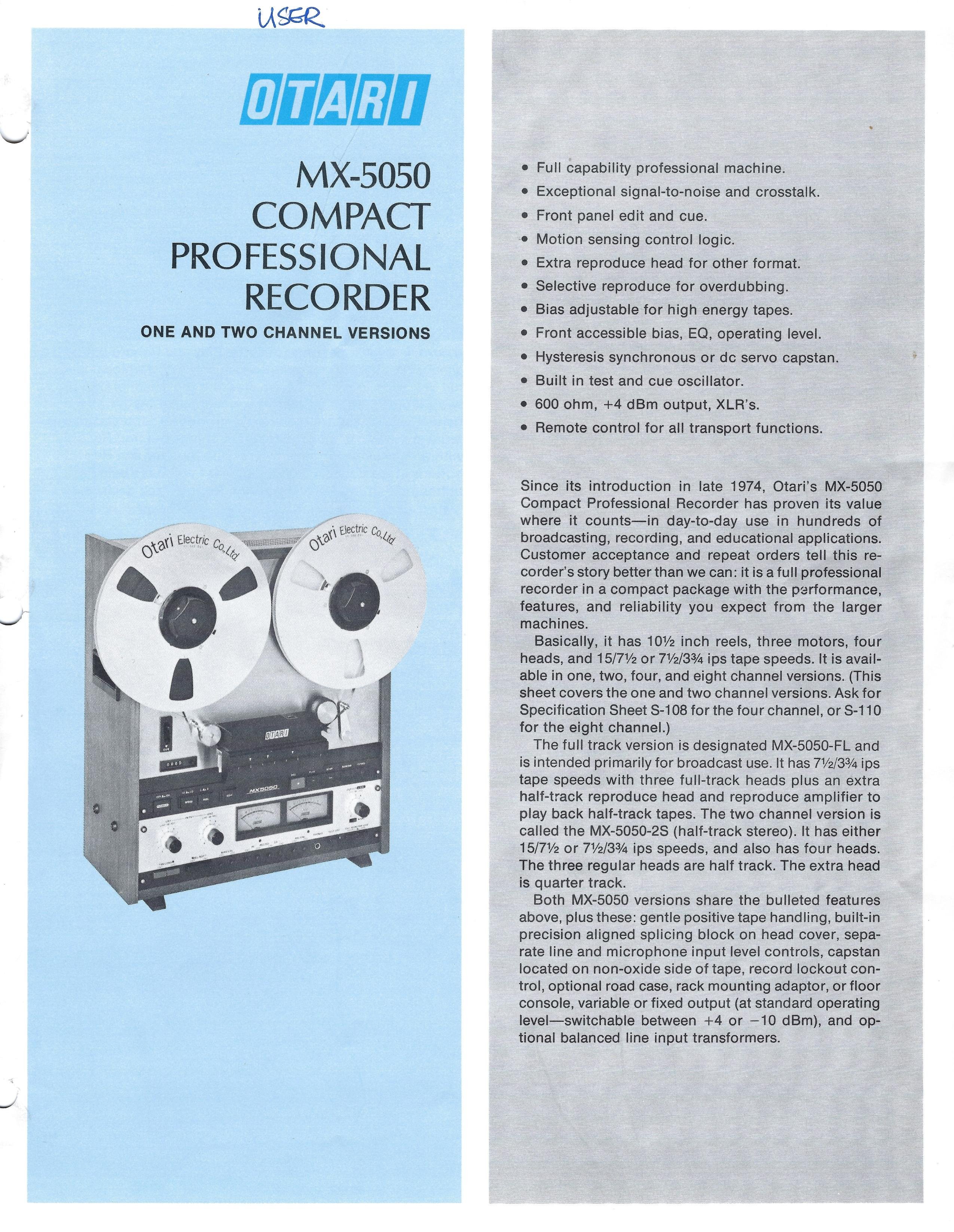 ⤢ zoomThe MX-5050 photographed from above and to the side in its cabinet, twin reels marked Otari Electric Co.,Ltd. threaded across the heads
Introduction↑ TOP
- Full capability professional machine.
- Exceptional signal-to-noise and crosstalk.
- Front panel edit and cue.
- Motion sensing control logic.
- Extra reproduce head for other format.
- Selective reproduce for overdubbing.
- Bias adjustable for high energy tapes.
- Front accessible bias, EQ, operating level.
- Hysteresis synchronous or dc servo capstan.
- Built in test and cue oscillator.
- 600 ohm, +4 dBm output, XLR's.
- Remote control for all transport functions.
Since its introduction in late 1974, Otari's MX-5050 Compact Professional Recorder has proven its value where it counts—in day-to-day use in hundreds of broadcasting, recording, and educational applications. Customer acceptance and repeat orders tell this recorder's story better than we can: it is a full professional recorder in a compact package with the performance, features, and reliability you expect from the larger machines.
Basically, it has 10½ inch reels, three motors, four heads, and 15/7½ or 7½/3¾ ips tape speeds. It is available in one, two, four, and eight channel versions. (This sheet covers the one and two channel versions. Ask for Specification Sheet S-108 for the four channel, or S-110 for the eight channel.)
The full track version is designated MX-5050-FL and is intended primarily for broadcast use. It has 7½/3¾ ips tape speeds with three full-track heads plus an extra half-track reproduce head and reproduce amplifier to play back half-track tapes. The two channel version is called the MX-5050-2S (half-track stereo). It has either 15/7½ or 7½/3¾ ips speeds, and also has four heads. The three regular heads are half track. The extra head is quarter track.
Both MX-5050 versions share the bulleted features above, plus these: gentle positive tape handling, built-in precision aligned splicing block on head cover, separate line and microphone input level controls, capstan located on non-oxide side of tape, record lockout control, optional road case, rack mounting adaptor, or floor console, variable or fixed output (at standard operating level—switchable between +4 or −10 dBm), and optional balanced line input transformers.