The MARK III Series Brochure (1984) — Digital Edition · Part 3 · scan pages 7
The MARK III/4 ½″ Four-Channel Recorder
Otari heads the page with two markets, set as a checklist:
- BROADCAST — multi-track production for stereo
- TELEVISION & FILM — ½″ four-channel mixdown for audio post-production
The opening copy rests the machine's case on audio performance and full overdubbing capability, and then does something no other page in the book does: it points the reader at a cheaper machine. "For maximum performance with minimum investment cost, a ¼″ four-channel recorder, the BQII, is also available," suited to high quality multi-image production — the upright four-track that shares the last column of the comparison grid.
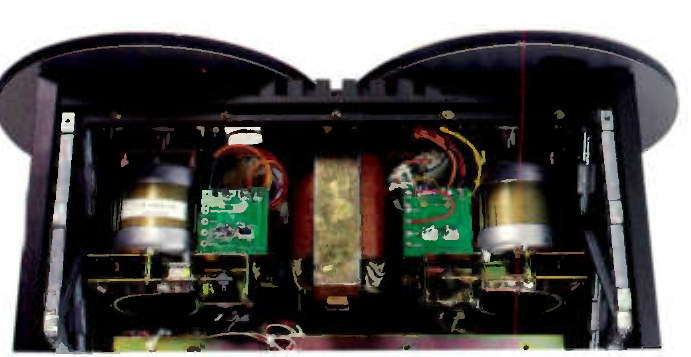 ⤢ zoomThe inside of the machine with its head cover raised: two large reel motors at left and right, a shielded transformer at the centre, and green circuit boards mounted between them on the underside of the deck.
High-torque, AC reel motors for fast tape winding power, and a DC servo capstan motor for precise tape speed control, make the MARK III Series perfect for interface to editors and tape machine controllers.
Professional Features that make the MARK III/4 easy to use↑ TOP
- Independently switchable +4 dBm or −10 dBV input and output reference levels on each channel
- Heavy-duty locking, XL type input/output connectors
- Built-in test oscillator (1 kHz and 10 kHz), and external oscillator input
- Dual-element metering: user-adjustable peak reading LEDs plus standard VU
- Headphone amplifier with channel select and level control
- Microphone inputs with 20 dB pad
- Adjustable low frequency compensation
- Microprocessor-controlled hours/minutes/seconds real-time counter with zero-return and LED display
- Front panel Cue control (tape lifter defeat)
- Full-function auto locator (CB-116) optionally available
- Integral tape splicing block
Features that deliver superb Tape Handling and Transport Control↑ TOP
- Microprocessor-governed transport control logic, motion sensing and dynamic braking
- ±7% variable speed control (+50%, −100% speed via external control), usable in Record and Reproduce
- Reel size switch selectable — 5″, 7″, 10.5″, EIA or NAB
- High torque, AC reel motors
Additional features for Flexibility, Reliability, and Serviceability↑ TOP
- Speed selection of 15 or 7.5 ips, with 60 minutes record time at 7.5 ips
- Plug-in optimized three head design with easy access, hinged head cover
- Zero-return button operates from positive or negative tape locations
- Interface connector for external machine control via SMPTE/EBU time-code-based editors, machine controllers or synchronizers
- Positive-locking NAB hub adaptors
- Easy access, plug-in circuit boards put all adjustments for each channel on a single card
- Automatic monitor switching
- Rack mounting kit RK-34 (optional)
- Roll-around floor stand ZA-52L-34 for variable-profile mounting (optional)
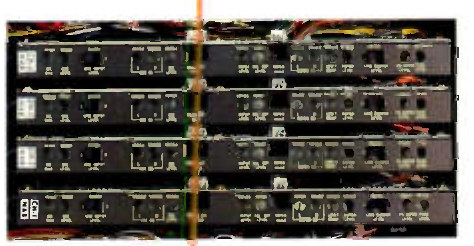 ⤢ zoomFour horizontal plug-in circuit cards stacked in a chassis, each carrying a row of trimmer adjustments and connector fingers, photographed from the front with coloured wiring visible at the edges.
Easy access electronics with plug-in circuit boards put all adjustments for each channel on a single card.