The MX-5050 Series Data Sheet (1991) — Digital Edition · Part 2 · scan pages 2
Features, Accessories and Options
Standard Features:↑ TOP
- Built-in mini-autolocator with four one-touch cue-point memories, search zero and repeat functions
- The tape timer reads HRS/MINS/SECS as well as tape speed in inches per second and percentage of tape speed
- Positive-action transport controls with microprocessor governed logic, motion sensing, and dynamic braking
- 37 pin Otari standard parallel interface for external machine control via SMPTE/EBU time-code-based synchronizers and editors
- DC capstan, Quartz PLL servo-controlled
- Automatic monitor switching¹
- Plug-in, single card per channel electronics
- Gapless, seamless, punch-in, punch-out¹
- Rehearse function²
- Built-in test oscillator and external oscillator input
- Independently switchable +4 dBu or -16 dBu input and output reference level on each channel (MKIV-4, 8, BQIII).
- Active Balanced Transformerless XL type input and output connectors
- Headphone monitoring of any selected channel combination
- Plug-in three head design with easy access, hinged head cover
- Lighted VU Meters with peak-reading indicators
- Front panel record setup adjustments
- 3 speeds switch selectable in 15/7.5 ips or 7.5/3.75 ips speed pairs³
- Fourth head switch selectable for ¼" track stereo playback (B-IIIF only)
- Record reference level is switch selectable (see specifications)
- Equalization switch selectable (NAB/IEC)
- Variable speed control (±20%) usable in record and play
- Dump Edit and Cue (lifter defeat) modes
- Reel Size switches selectable for take-up and supply reels (5"-7," 10.5") EIA or NAB
- Microphone and line mixing on each channel
¹ BQ-III, MARK IV-4 & 8 only
² MARK IV-4 & 8 only
³ 7.5/3.75 ips optional on BQ-III, MARK IV-4 & 8
Standard Accessories:↑ TOP
- Power cord
- Operation manual
- Reel hold down knobs
- Capstan lubricating oil
- Fuses
Options:↑ TOP
| CB-119 | Autolocator |
| CB-120 | Autolocator |
| CB-127 | Remote controller |
| CB-144 | Remote controller (MKIV-8) |
| EC-102 | Synchronizer |
| CB-131 | Remote for EC-102 |
| EC-401 | Resolver |
| ZA-53T | Input transformer (B-IIIF, 2, 2E, MKIV-2, 2E) |
| ZA-53S | Output transformer (B-IIIF, 2, 2E, MKIV-2, 2E) |
| ZA-52L | Roll-around stand |
| RK-2B | Rack mount kit (B-IIIF, 2, 2E, BQ-III) |
| KH-44KB | Full track kit |
| PB-7WXA | Extension PCB (MKIV-4, 8, BQ-III) |
| PB-7OQA | Extension PCB (MKIV-4, BQ-III) |
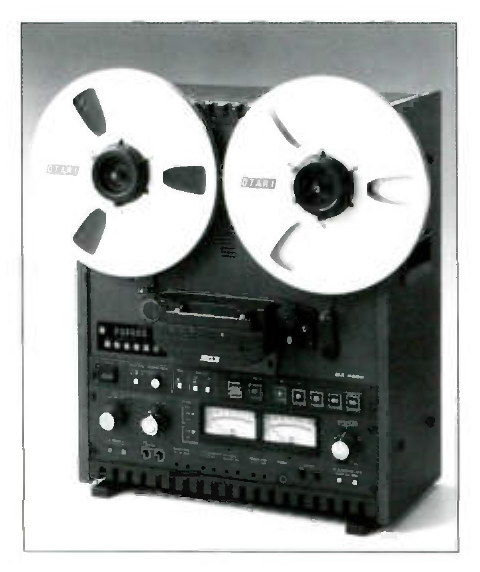 ⤢ zoomA recorder standing upright, photographed slightly from the left against a grey ground: two white Otari NAB reels side by side at the top, the head block and tape path below them behind a hinged cover, a row of six small keys at the left of the deck, and across the lower panel a pair of large knobs, two lighted VU meters, four square function keys and a rotary control at the right, over a finned vent strip along the bottom edge.
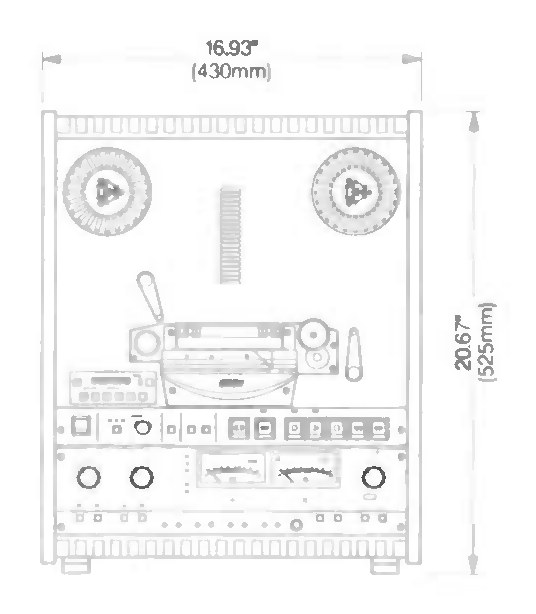 ⤢ zoomFront elevation of the recorder standing upright, drawn as a fine grey line diagram: the two reel tables at the top with the tape path and head block between them, a row of transport and function keys across the middle, and two VU meters flanked by rotary controls below. It is dimensioned 16.93" (430mm) across the top and 20.67" (525mm) down the right-hand side.
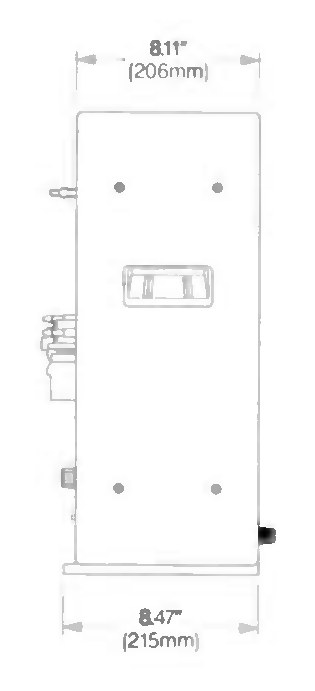 ⤢ zoomSide elevation of the same upright recorder as a fine grey line diagram: a tall rounded rectangle for the side panel with four fixing points, a rectangular recess at its centre, connectors standing out from the left-hand (rear) edge and a small fitting at the lower right, all on a base rail that overhangs the panel slightly. It is dimensioned 8.11" (206mm) across the top and 8.47" (215mm) across the base.
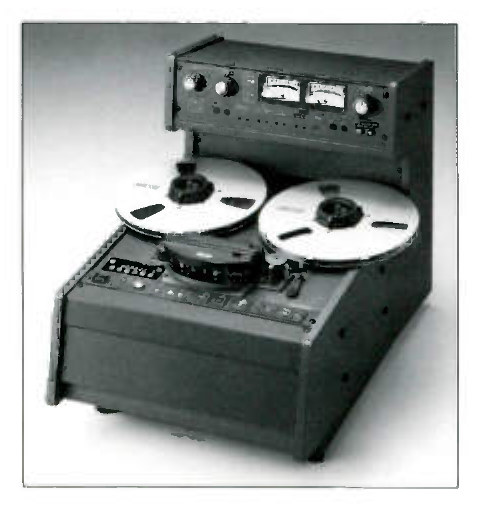 ⤢ zoomA recorder built as a desk-top unit, seen from the front and a little to the left: a separate electronics panel with two rotary controls, two lighted VU meters and a further knob stands across the back on a raised bridge, the transport lies back below it with two white Otari NAB reels flat and the head block between them, and the whole sits in a plain wedge-shaped cabinet on small feet.
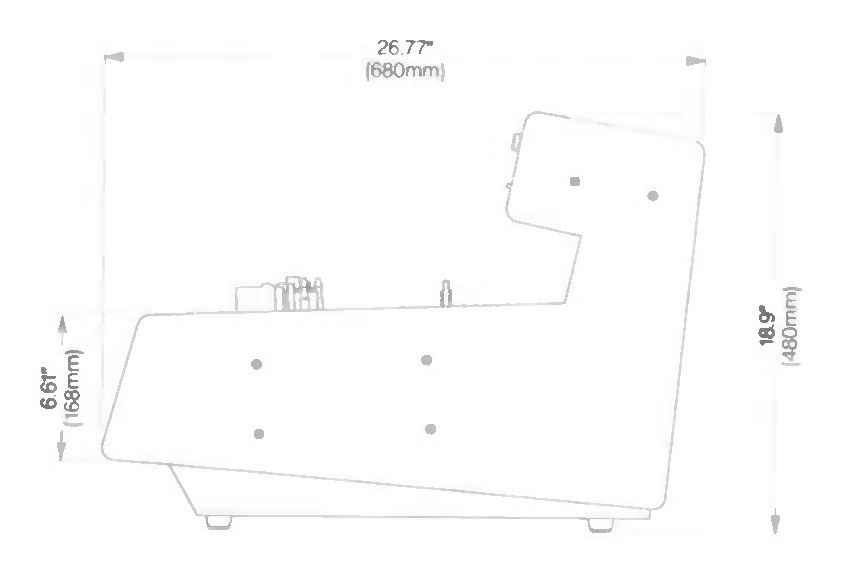 ⤢ zoomSide elevation of the desk-top cabinet as a fine grey line diagram: a long wedge with a low rounded front edge at the left, rising to the raised rear section that carries the electronics panel at the right, with the head block and a guide standing proud of the sloping deck, and six fixing points along its side — four round ones set as two pairs on the sloping panel, and on the raised rear section a square one and a round one. The whole stands on two small feet. It is dimensioned 26.77" (680mm) across the top for the overall depth, 18.9" (480mm) down the right-hand side for the overall height, and 6.61" (168mm) at the left for the height of the low front edge.
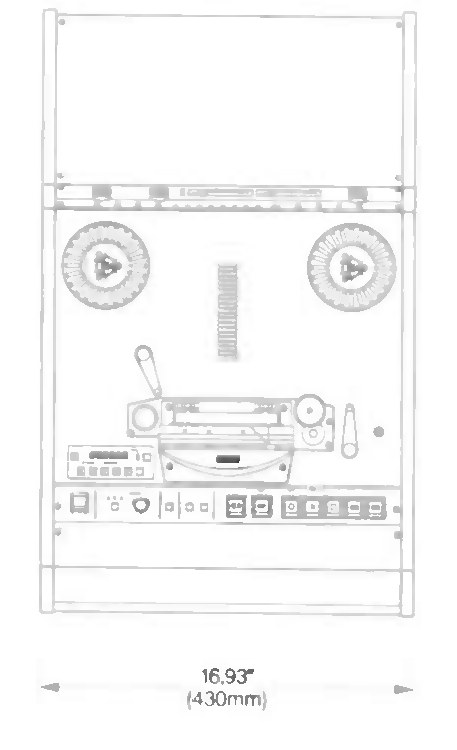 ⤢ zoomFront elevation of the desk-top cabinet as a fine grey line diagram, turned the right way up: the side panels rise as narrow rails at either edge and a plain panel fills the top of the cabinet. Below it the deck shows the two knurled reel hold-down knobs to left and right of a vertical tape-path detail, the head block with capstan and pinch roller beneath them, and a row of small keys and switches along the front. It is dimensioned 16.93" (430mm) across the foot.