The MX-5050 Series Data Sheet (1991) — Digital Edition · Part 1 · scan pages 1
Model 5050 Two, Four and Eight-Channel Recorders
Model 5050 Two, Four and Eight-Channel Recorders
The Otari MX-5050 Series allows the audio professional to select exactly the right machine for his or her application from a complete range of compact audio recorders. (Please see chart on specifications page.)
All machines feature an optimized three-head design and transformerless balanced inputs and outputs to provide superior frequency response, distortion and signal-to-noise performance under professional studio conditions. They are compatible with all dbx * noise reduction products. Record setup adjustments can be made from the front panel, and a convenient built-in oscillator provides test tones for calibration/maintenance.
* Trademark dbx, Incorporated
Gapless, seamless, punch-in, punch-out (GSPIPO™) is available on the BQ-III, Mark IV-4, and Mark IV-8 models. This system produces inaudible record inserts by using carefully controlled bias ramping to eliminate the "thump" in the recording.
A direct-drive capstan motor is servo controlled, and an integral microprocessor governs tape handling, including dynamic braking, motion sensing and transport logic. A built-in mini-autolocator provides four one-touch cue-point memories, search zero, and a repeat function. The tape timer display shows tape time in Hrs/Mins/Sec., as well as tape speed in inches per second and percentage of tape speed. Capstan speed can be varied by ±20% in 0.01% steps using the built-in "pitch" control.
Time-code editing using a synchronizer is accomplished via the 37 pin Otari standard parallel interface.
The extremely rugged mechanical construction includes a ⅛" deckplate with cast aluminum side panels and steel support members. All circuit boards are designed to swing out or unplug for full service access.
Several transport remote controls are available as options, as well as a roll-around floor stand.
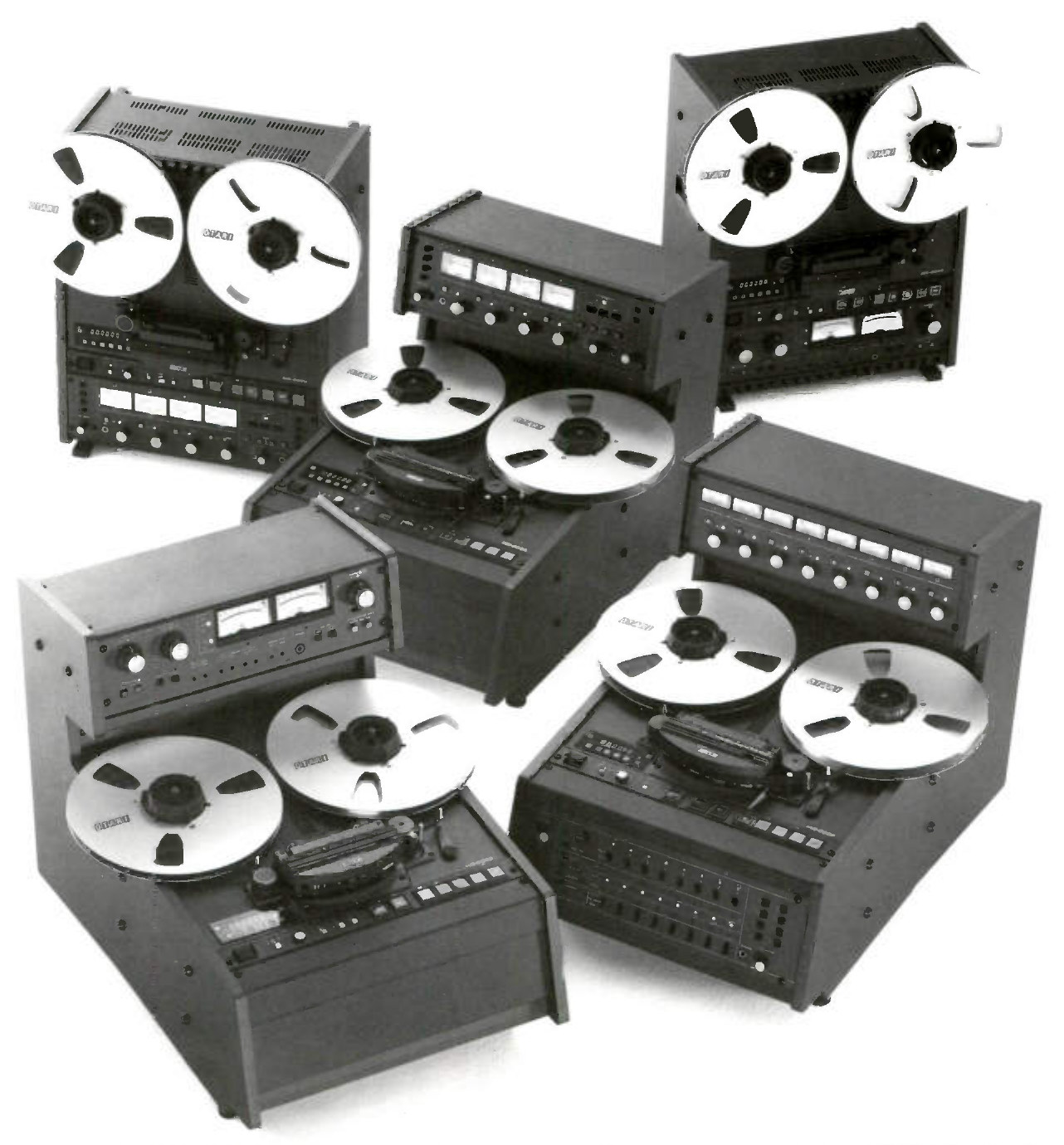 ⤢ zoomFive machines of the series grouped together on plain white paper, each carrying a pair of large pale reels. Two at the back stand upright, their reels vertical above the transport and electronics in the cabinet below; the three in front are desk-top cabinets whose decks lie back, so their reels are seen from above, each with its electronics on a raised bridge behind the deck. The bridge of the desk-top at the front left carries two meter faces; the bridges of the desk-top in the middle and of the larger one at the front right each carry a row of meter faces, the latter over a matching row of knobs.