The MARK III Series Brochure (1984) — Digital Edition · Part 0 · scan pages 1-3
Cover and Introduction
 ⤢ zoomThe brochure's dark front cover: an MX-5050 transport photographed from above in near-darkness, one reel flange catching the light, the Otari wordmark at the head of the deck and again on the reel hub, with the transport control row — RECORD, PLAY, STOP, REWIND, F•FWD — lit across the foot of the page.
THE MARK III SERIES — Technology you can Trust.
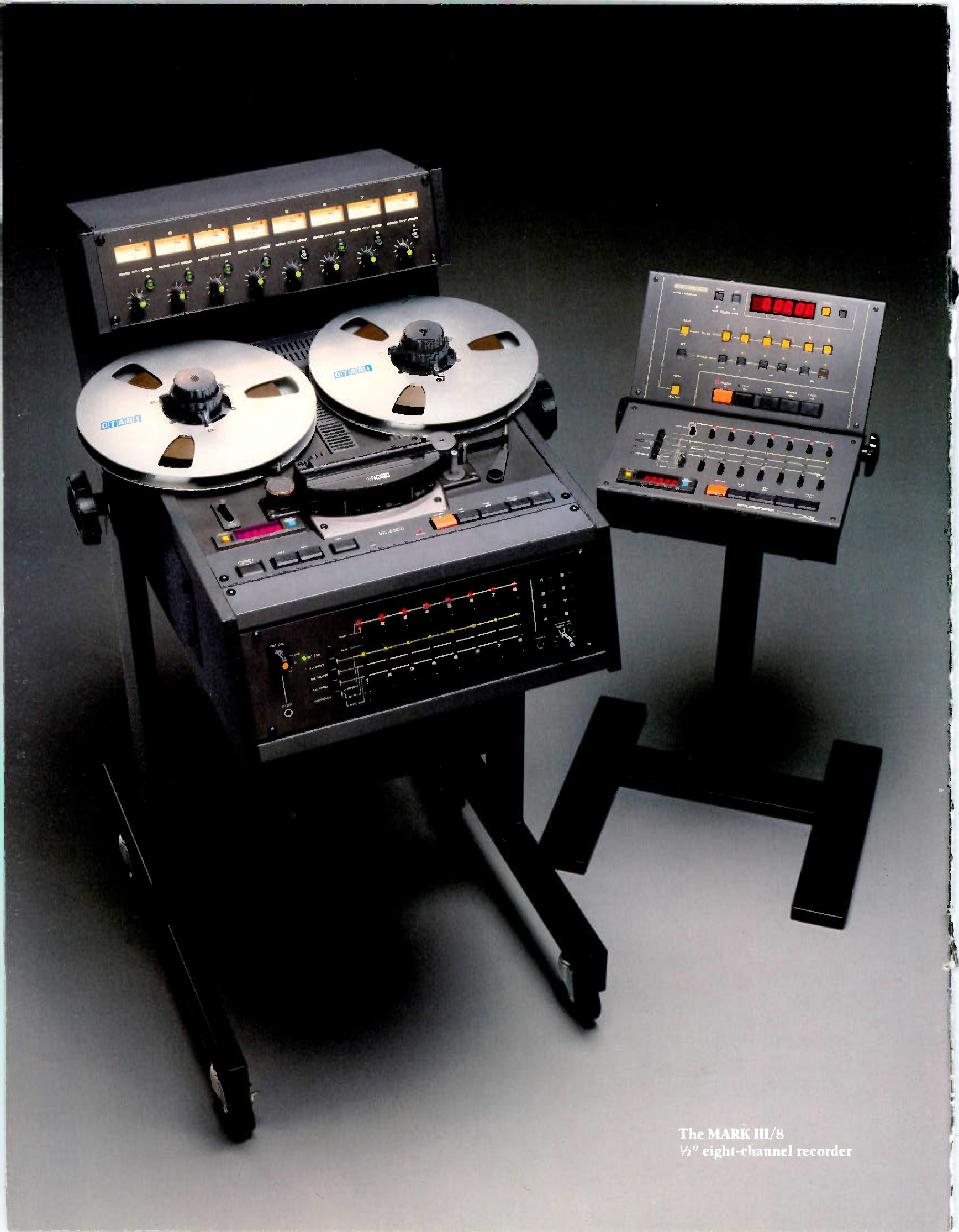 ⤢ zoomThe MARK III/8 on its roll-around floor stand: the eight-channel electronics in a rack unit at the top, two white NAB reels on the transport below them, the meter bridge and its LED ladders across the front of the machine, and the CB-110 remote session controller on a second stand at the right, the whole on castered legs.
The MARK III/8 ½″ eight-channel recorder
The introduction↑ TOP
Otari's headline claims the series as "a complete line of professional audio tape recorder/reproducers" for broadcast production, audio post-production and recording studio work — the three markets each machine page then repeats as a checklist of its own.
The facing copy introduces the three recorders in turn and says what each is for:
- MARK III/2 — the ¼″ two-channel, pitched at recording studio mixdown and broadcast editing. For audio-for-video and film sound, Otari names an optional speed resolver, the EC-401, that makes it "the right choice for daily transfer applications using pilot-tone synchronization."
- MARK III/4 — the ½″ four-channel, offered as the format that "has been the world standard for both audio post-production mixdown and broadcast production," and sold on price.
- MARK III/8 — the ½″ eight-channel, which Otari lines up against its own MTR-90 for features and against 1″ eight-channel machines for performance, and aims at stereo radio production and at post-production houses that need to talk to SMPTE time-code editors, machine controllers and synchronizers through its interface connector.
The section closes by promising the reader performance, sound and long-run reliability "in the most sophisticated production studio, or in your own home studio" — the only place in the book that reaches past the professional buyer.
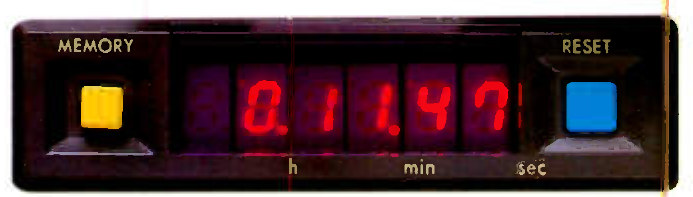 ⤢ zoomA close-up of the black counter module: a yellow MEMORY button at the left, six red seven-segment digits reading 0.11.47 across the centre with h, min and sec legends beneath them, and a blue RESET button at the right.
The zero return and reset electronic counter, with an hours/minutes/seconds display, is tape accurate at all operating speeds.