Operation manual (OIM-1005E) · Part 1 · scan pages 9-17
General Information
The MX-5050 Series Professional Recorders are professional quality two-speed audio tape recorder/reproducers designed for optimum performance and long life. The systems are available mounted in a standard wooden case, optional portable case, or mounted for vertical or horizontal installation in a rack or custom console.
The MX-5050 Series use ¼-inch tape and are available in eight different model configurations as shown in Table I-1. The configuration is determined by the tape-speed pair and the tape recording and reproducting format.
Table I-1. MX-5050 Model Configurations
| Model No. | Tape Speed (in/sec) | Recording Method | Peproducing Method |
|---|---|---|---|
| MX-5050-2SHT MX-5050-2SL | 15 & 7½ 7½ & 3¾ | ½-track 2 channel Stereo ½-track Monaural Recording with synchronous reproduction | ½-track 2 channel Stereo ¼-track 2 channel Stereo |
| MX-5050-4SH MX-5050-4SL | 15 & 7½ 7½ & 3¾ | ¼-track 2 channel Stereo ¼-track Monaural Recording with synchronous reproduction | ¼-track 2 channel Stereo ½-track 2 channel Stereo |
| MX-5050-QXH MX-5050-QXL | 15 & 7½ 7½ & 3¾ | ¼-track Quad Stereo ¼-track Monaural Recording with synchronous reproduction | ¼-track Quad Stereo ¼-track 2 channel Stereo |
| MX-5050-FH MX-5050-FL | 15 & 7½ 7½ & 3¾ | Full track Monaural | Full track Monaural |
I-1. SYSTEM DESCRIPTION↑ TOP
Among the many professional features of the MX-5050 Series are: selective reproduction, motion sensing, edit control that permits spilling and rocking, adjustable cueing control for audible monitoring in fast forward and rewind, built-in test and cue-tone oscillator, front adjustable bias and equalization controls, XLR type connectors for input and output lines, standard reference level output calibration control, separate line and microphone input level controls for each channel, a VU meter for each channel, and an optional DC capstan servo with variable control of each capstan speed.
I-1-(1) TAPE TRANSPORT↑ TOP
All components of the tape transport are mounted on a rigid aluminum base for stability. The transport design incorporates two 6-pole induction motors for the reels and a 2-speed hysteresis-synchronous motor for the capstan. Speed selection is made by operation of a front panel pushbutton switch which also switches equalization. The operating speed pairs of each model MX-5050 are summarized in Table I-2.
Table I-2. Available Standard Tape-Speed Combinations
| Model Type | Model Numbers | Speed Combination — High | Speed Combination — Low |
|---|---|---|---|
| High Speed | MX-5050-2SHT, -4SH, -QXH, -FH | 15 in/sec | 7½ in/sec |
| Low Speed | MX-5050-2SL, -4SL, -QXL, -FL | 7½ in/sec | 3¾ in/sec |
The transport accomodates tape reels 10-½ inches, 8 inches, 7 inches, and 5 inches in diameter in NAB or EIA hub configuration. A solenoid-actuated tape lifter lifts the tape away from the heads in fast forward and rewind modes in addition to stop mode to increase head and tape life.
In addition to the editing controls, a tape-splicing block (Fig. III-2) mounted on the head cover holds the tape for ease of editing, cutting, and application of splicing tape.
Momentary contact pushbutton controls on the transport are used to select operational modes, record, play, stop, rewind, and fast forward. These modes may be controlled from a remote location by means of an optional remote control unit (Table I-5).
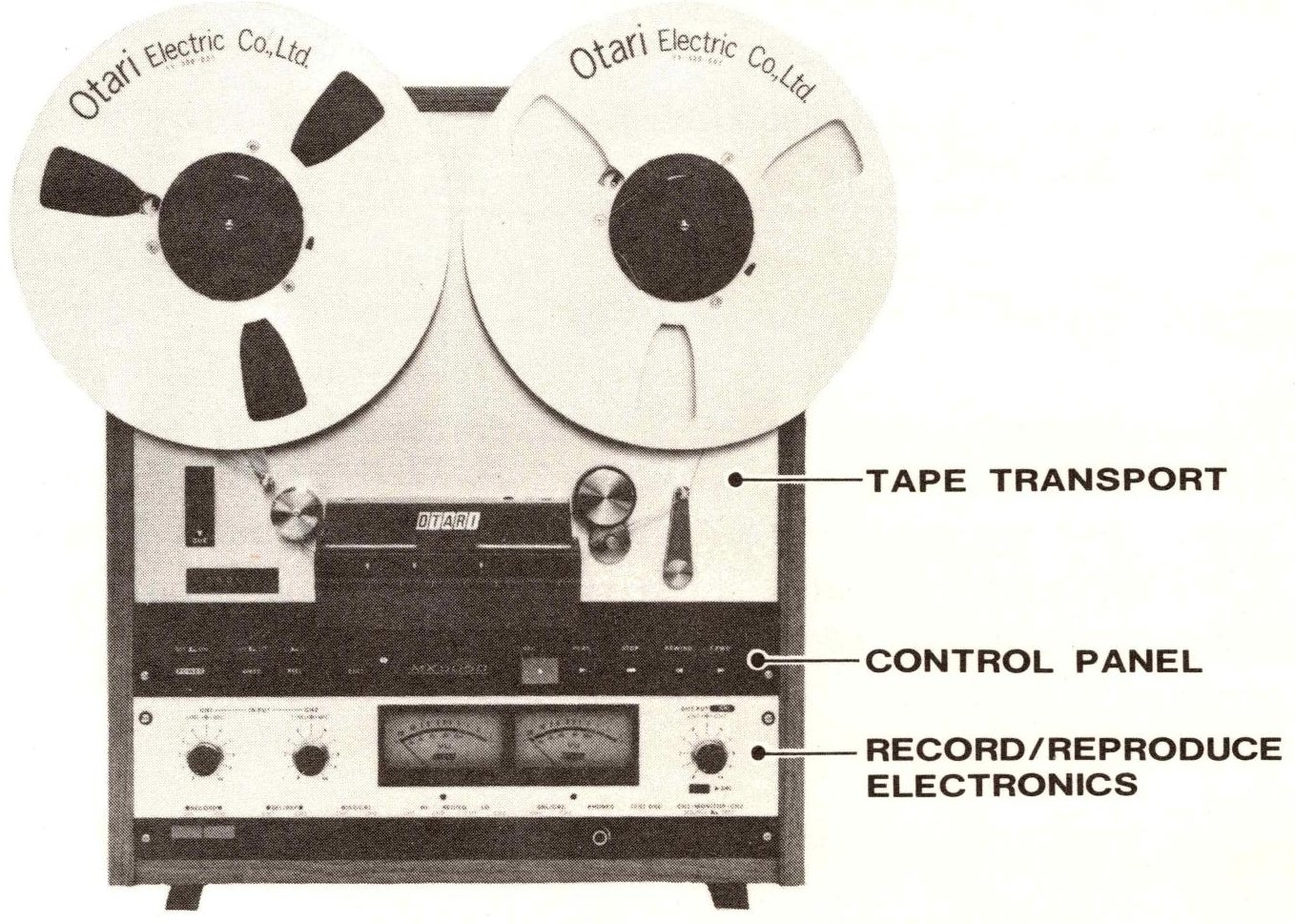 ⤢ zoomMX-5050 recorder chassis with two reels mounted, front panel labeled to show the tape transport, control panel, and record/reproduce electronics sections
Fig. I-1 MX-5050 Major Components
I-1-(2) RECORD/REPRODUCE ELECTRONICS↑ TOP
The record/reproduce electronic unit is located directly beneath the transport control panel and since each unit provides two separate channels of record/reproduce electronics, two units are required for a four channel simultaneous-record/reproduce system. Each unit is complete including a bias oscillator, selective reproduce controls, and facilities for setting standard reference level. The electronics are all solid state and are primarily contained on printed circuit boards to facilitate maintenance.
I-1-(3) HEAD ASSEMBLIES↑ TOP
As viewed from the front of the recorder, the configuration of the head assembly in each model MX-5050 is as shown in Table I-3.
Table I-3. Head Assembly Configuration
| Model No. | H1 | H2 | H3 | H4 | Recording Method |
|---|---|---|---|---|---|
| *MX-5050-2SHT *MX-5050-2SL | Erase ½T/2ch | *Playback ¼T/2ch | Record ½T/2ch | *Playback ½T/2ch | ½-track 2 channel Stereo ½-track Monaural Recording with synchronous reproduction |
| *MX-5050-4SH *MX-5050-4SL | Erase ¼T/2ch | *Playback ½T/2ch | Record ¼T/2ch | *Playback ¼T/2ch | ¼-track 2 channel Stereo ¼-track Monaural Recording with synchronous reproduction |
| **MX-5050-QXH **MX-5050-QXL | **Erase ¼T/2ch | **Erase ¼T/2ch | Record ¼T/4ch | Playback ¼T/4ch | ¼-track Quad Stereo ¼-track Monaural Recording with synchronous reproduction |
| MX-5050-FH MX-5050-FL | Erase Full T. | *Playback ½ T/2ch | Record Full T. | *Playback Full T. | Full track Monaural ½-track 2 channel Stereo |
Note: * The head assembly of these models contain two playback head stacks. A head change-over switch on the head assembly permits selection of either head stack.
** The erasing of MX-5050-QX is performed by two staggered erase heads (H1 & H2).
I-2. STANDARD ACCESSORIES↑ TOP
The MX-5050 is supplied with the standard accessories listed in Table I-4.
Table I-4. Standard Accessories
| Description | Quantity | Otari Part No. |
|---|---|---|
| Connecting Cable (QX Only) | 1 | TZ-127-026 |
| NAB Hub Reel Hold Down Knob | 2 | TW-661 |
| Reel Adjusting Disc (Shim)* | 2 | TY-506 |
| Fuse (2 Ampere) | 1 | FS-1-2A |
| Otari Takeup Reel, 10-½ inch | 1 | TY-500 |
| Operation Manual | 1 | OIM-1005E |
* The reel-adjusting disc (shim) is placed between the metal and the turn-table to compensate the thickness between metal reels and plastic reels.
I-3. OPTIONAL ACCESSORIES↑ TOP
Available optional accessories are listed in Table I-5.
Table I-5. Optional Accessories
| Description | Otari Part No. |
|---|---|
| Rack Mount Adaptor | CS-252 |
| Portable Case | CS-253 |
| Speed Conversion Kit (for 50 Hz) | TZ-220 |
| Speed Conversion Kit (for 60 Hz) | TZ-221 |
| Remote Control Unit (2S, 4S) (QX) | CR-705 CR-705A |
| Dust Cover (2S, 4S) (QX) Amplifier Tape Transport | TY-559 TY-500-064 TY-500-063 |
| Balanced Input Line Transformer, 600 ohms | ET-21-181 |
| Balanced Output Line Transformer, 600 ohms | ET-31-182 |
| Cleaning Kit | TY-502 |
| Maintenance Manual | OMM-1003E |
I-4. SERVICE AND REPLACEMENT PARTS↑ TOP
For service and replacement parts, or any necessary technical support, please contact your nearest service center, Otari dealer or write to Otari. (See page ii in detail.)
I-5. SPECIFICATIONS↑ TOP
The specifications of MX-5050 Series are as listed in Table I-6.
Table I-6. Specifications of MX-5050 Series
| Tape Width & Channels: | ¼ inch (6.3mm) tape: 2 channel (0.075 in. or 1.9mm track width) 4 channel (0.040 in. or 1.0mm track width) |
| Tape Speeds: | 7½ and 15 ips (19 and 38 cm/s) or 3¾ and 7½ ips (9.5 and 19 cm/s) Maximum deviation 0.15% measured with 1.5 mil (0.038mm) tape (Hysteresis synchronous motor). |
| Reel Size: | 7 inch plastic or 10½ inch, EIA or NAB |
| Heads: Two channel versions: | Model MX-5050-2S: Half-track Model MX-5050-4S: Quarter-track Four head stacks: MX-5050-2S: ½ erase, ¼ reproduce, ½ record, ½ reproduce. MX-5050-4S: ¼ erase, ½ reproduce, ¼ record, ¼ reproduce. |
| Heads: Four channel versions: | Model MX-5050-QX Four head stacks: erase (tracks 1 & 3), erase (tracks 2 & 4), ¼ record, and ¼ reproduce. Other head configurations available on special order. |
| Motors: Capstan: | Two speed hysteresis synchronous or DC servo controlled motor. (Pitch control limits ± 7%) |
| Motors: Reels: | Two induction torque motors. |
| Connectors: | Line input and line output, standard three-pin XLR. Microphone, standard ¼ inch phone jack. |
| Inputs: Line: | Minimum −15 dBm, unbalanced 50,000 ohms. Minimum −15 dBm, balanced 600 ohms with optional transformer. |
| Inputs: Microphone: | Minimum −70 dBm, unbalanced, nominal 50,000 ohms (high impedance). |
| Outputs: Line: | Level: +4 dBm or −10 dBm, rear panel switch selectable. Headroom: +19 dB before clipping. Impedance: MX-5050-2SHT: 600 ohms, balanced MX-5050-2SL, MX-5050-4S and MX-5050-QX: 600 ohms unbalanced (600 ohms balanced with optional transformer). |
| Outputs: Headphone Jack: | −24 dBm, nominal 8 ohms unbalanced. |
| Equalization: | NAB standard for 3¾, 7½ and 15 ips (EIA, CCIR, and IEC also available). |
| Frequency Response: | 15 ips.: 35 Hz to 22,000 Hz ± 2 dB 7½ ips.: 30 Hz to 18,000 Hz ± 2 dB 3¾ ips.: 30 Hz to 12,000 Hz ± 2 dB Specifications referred to 1,000 Hz reference when recorded on 3M 250 or Ampex 456 or equivalent tape using unbalanced output. |
| Signal to Noise Ratio: |
| Tape Speed | ½ Track, Weighted | ½ Track, Unweighted | ¼ Track, Weighted | ¼ Track, Unweighted |
|---|---|---|---|---|
| 15 ips. | 68 dB | 65 dB | 65 dB | 62 dB |
| 7½ ips. | 68 dB | 65 dB | 65 dB | 62 dB |
| 3¾ ips. | 67 dB | 64 dB | 64 dB | 61 dB |
| Crosstalk: | At 1,000 Hz on adjacent tracks: 2S: greater than 60 dB 4S: greater than 55 dB QX: greater than 50 dB |
| Flutter and Wow: | (Measured per NAB weighted): |
| Tape Speed | |
|---|---|
| 15 ips. | less than 0.05% |
| 7½ ips. | less than 0.06% |
| 3¾ ips. | less than 0.15% |
| Distortion: | Less than l% at 1,000 Hz at 185 nWb/m |
| Test Oscillator Frequency: | Nominal 1,000 Hz |
| Bias and Erase Frequency: | 133 kHz |
| Operating Position: | Vertical or horizontal |
| Power Requirements: | 117 volts, 60 Hz, single phase ac, 100 watts. Or 220/240 volts, 50 Hz, single phase ac, 100 watts (2S, 4S). 120 watts (QX). |
| Operating Environment: | 40° to 104°F (5° to 40° C) 20 to 80% RH. |
| Storage Environment: | −5° to 113°F (−20° to 45° C) |
| Weight: in Standard Cabinet: | MX-5050-2S & -4S: 24 kgs. (53 lbs) MX-5050-QX: Tape Transport: 21 kgs. (46 lbs) Amplifier: 9.5 kgs. (21 lbs) |
| Weight: in Portable Case: | MX-5050-2S & -4S: 28 kgs. (62 lbs) MX-5050-QX: Tape Transport: 24 kgs. (53 lbs) Amplifier: 12 kgs. (25 lbs) |
| Mounting: | Walnut finish cabinet, portable case, or rack mounting kit. |
| Standard Accessories: | Empty 10-½ inch NAB reel, NAB reel precision hold down knob, fuse, NAB reel-adjusting disc (shim) and Operation Manual. |
Note 1. Signal to noise ratio is measured with respect to a record level of 520 nWb/m to biased tape noise when using Scotch 206 or equivalent high output low noise tape. Unweighted: Using a 30 to 18 kHz RC filter to attenuate noise outside the audio spectrum. Weighted: Using an NAB or ASA"A" weighting filter and 1,000 Hz reference.
-
Main schematic diagrams are attached to the last part of this manual.
-
Otari reserves the right to change specifications without notice and obligation.