2026-08-14
The reference tapes arrive
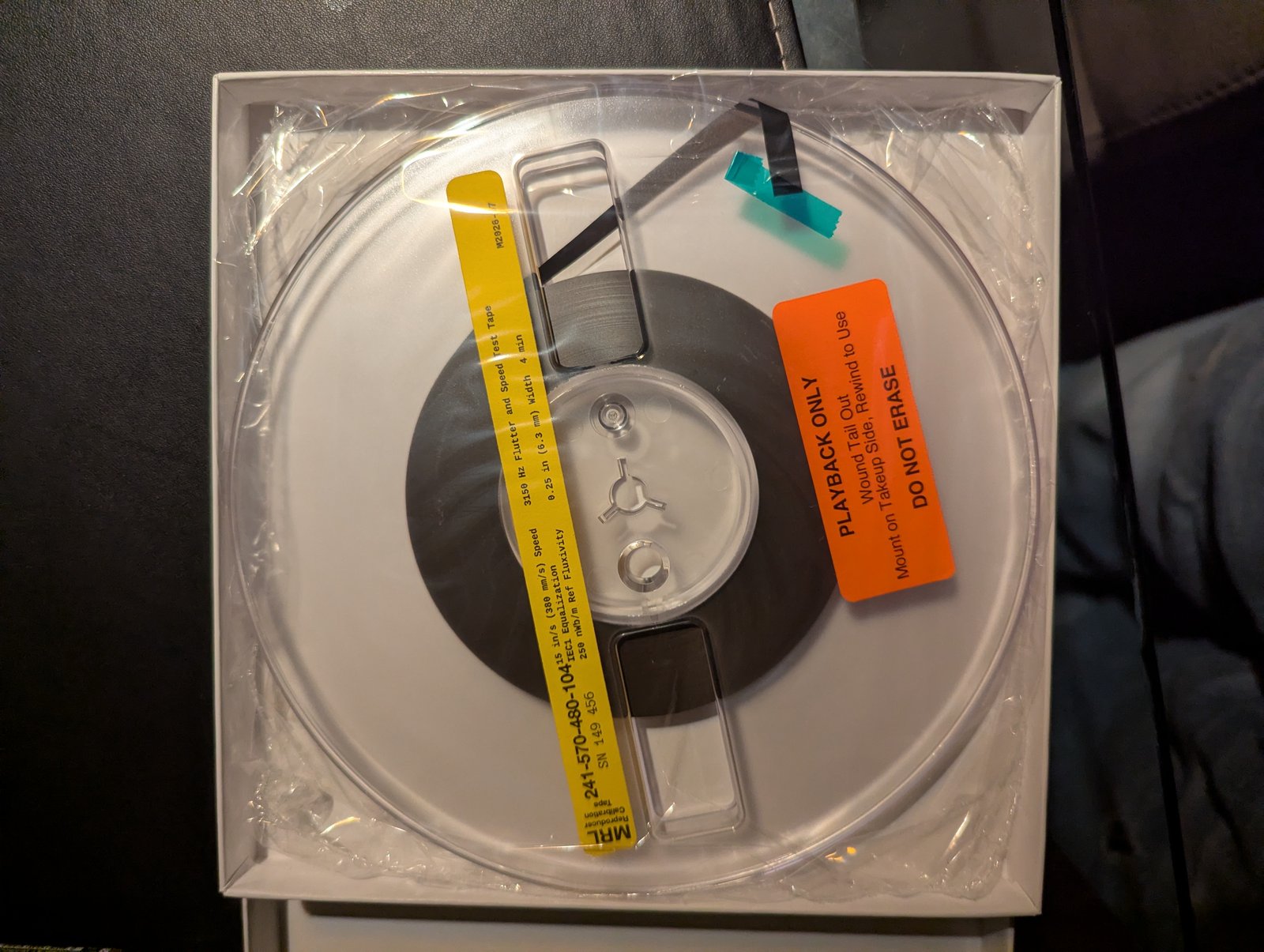
The last prerequisite for bench day arrived today: two reels from Magnetic Reference Laboratory in California, each in a plain white box with a yellow spine label, each wound tail out under an orange sticker that states its terms up front — "PLAYBACK ONLY — Wound Tail Out, Mount on Takeup Side, Rewind to Use — DO NOT ERASE." Both were made in July 2026. The reference tapes are younger than the groceries.
 The MRL multifrequency calibration tape on its clear reel, sealed in its box, yellow catalog label across the hub and the orange playback-only sticker beside it
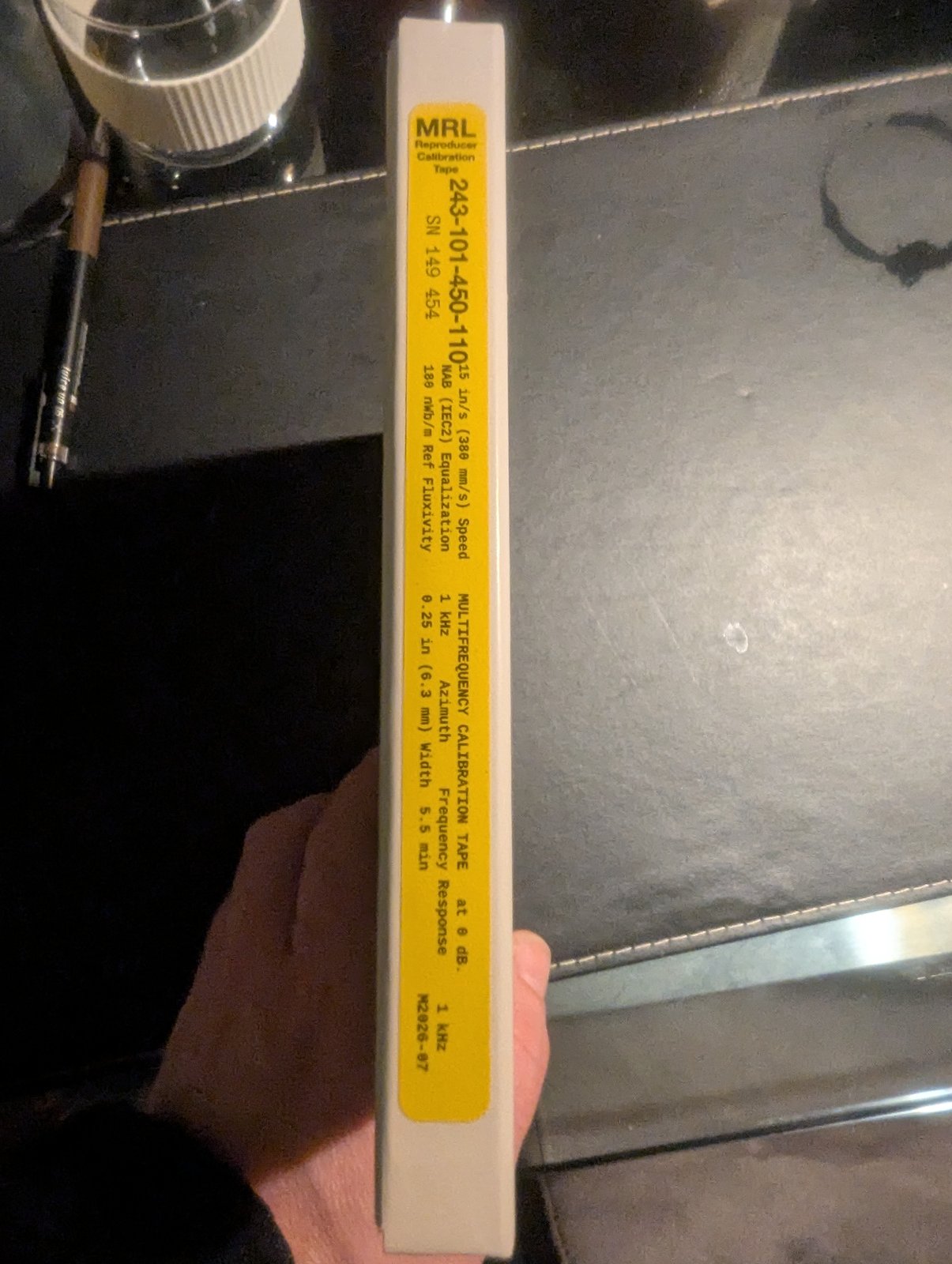
The first is the level tape: MRL Multifrequency Calibration Tape, catalog 243-101-450-110, serial 149 454 — 15 in/s, NAB equalization, 180 nWb/m reference fluxivity, all tones at 0 dB, five and a half minutes. One wrinkle worth recording: MRL's store sells this under the "Full Program" name, but the box and the enclosed graph both say Multifrequency Calibration Tape with a 243-series catalog number. Same substance either way — the contents match what was ordered.
The second is the speed-and-flutter tape: 241-570-480-104, serial 149 456 — a single 3150 Hz tone, four minutes, 250 nWb/m — exactly the catalog item the calibration guide predicted from the listing, down to the digit.
 The flutter and speed test tape on its clear reel in the box, catalog label across the hub, tail-out sticker in place
 The flutter tape's box spine: MRL Reproducer Calibration Tape 241-570-480-104, 15 in/s, IEC1 equalization, 250 nWb/m, 3150 Hz flutter and speed test tape, four minutes
The guide's very first bench check — read the tape's own calibration graph before trusting anything on the label or the listing — got done standing at the kitchen bench with the shrink wrap still curling on the floor. Every MRL tape ships with one: a strip-chart of the actual reel, plotted during production, one millimetre per 0.2 dB. Both of mine are scanned and hosted here — the multifrequency tape's graph (form G-1) and the flutter tape's (form G-0) — so the evidence reads alongside the claims. The multifrequency graph settles the question this site has been carrying for a week: it confirms 180 nWb/m at 1 kHz — which, per MRL's own documentation, is the old Ampex operating level of 185 nWb/m-at-700 Hz under its 1 kHz name. That is the exact reference the Otari manual calibrates to. The reference tone goes to 0 VU, no offset arithmetic, and the guide's adapted +14 dBm target for the maximum-reproduce-level step stands. The graph also plots the full tone sequence — 1 kHz reference, then 500 Hz, 8 kHz and 16 kHz for azimuth, then thirteen response tones from 32 Hz to 20 kHz, then 1 kHz out — matching the azimuth procedure the guide adapted, tone for tone.
The labels carry one small standards lesson worth passing on. The level tape says "NAB (IEC2) Equalization"; the flutter tape says "IEC1." That looks alarming for about ten seconds — the deck is a NAB machine — until the decoder ring clicks: IEC 60094-2 is the international designation for the NAB curve itself, and IEC1 is the CCIR-family curve. The level tape is NAB by its international name, and the flutter tape's equalization doesn't matter anyway — a single 3150 Hz tone plays no favorites between playback curves.
So the bench inventory is now complete: the tapes, the interface, the meter and the software, the recapped electronics, and a procedure with its first checkbox already ticked. What remains is the day itself — and the numbers get logged here, whatever they say.