2026-08-18
The announcer was slow
The reference tapes had been on the shelf four days. Bench day was meant to start with the reproduce alignment, so the 15 ips multifrequency tape went on, tail out, rewound, SPEED at HI, PLAY.
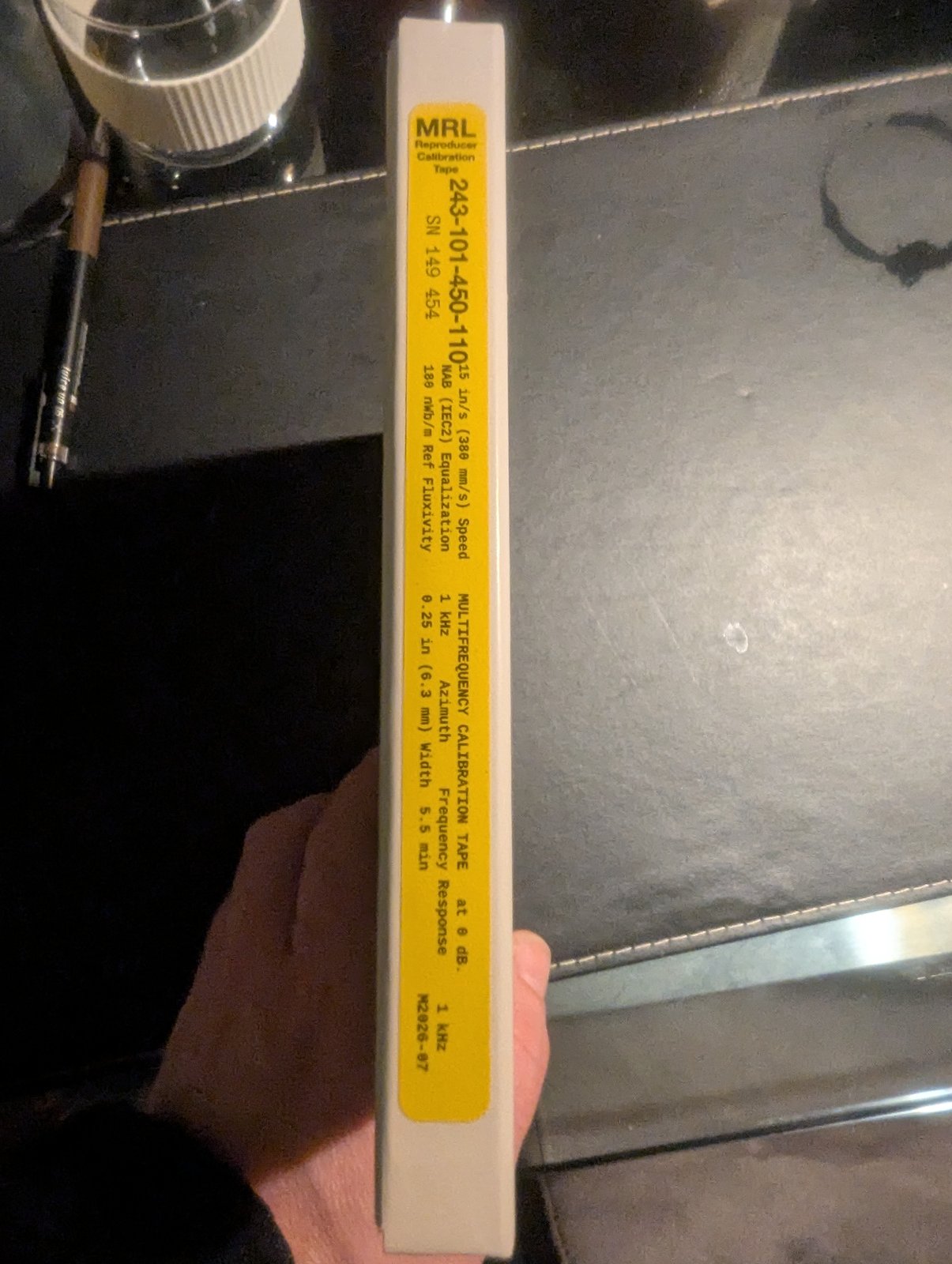 The MRL multifrequency calibration tape on its clear reel in its box, yellow catalog label across the hub and the orange playback-only sticker beside it
MRL tapes open with a spoken announcement before the tones. Mine came out low and slow — not a little slow, the unmistakable half-pitch drawl of a tape playing at half the speed it was made at. A 15 ips tape at 7.5 ips. The SPEED switch was at HI. I checked that first, and then again.
The second fact had been sitting in a box for weeks. My friend Gene's grandfather's reels — home recordings, the kind that were nearly always made at 3¾ ips to make a reel last — had only ever played at the right pitch on this deck at the LO position. I'd put that down to the tapes. It was the deck. Put the two together and there is only one reading: HI is 7.5 ips and LO is 3¾, the pairing Otari sold as its low-speed model.
What the paper says
The plate on the back reads 2SHT. The operation manual's Table I-2 is unambiguous about what that means: the high-speed models — 2SHT, 4SH, QXH, FH — run 15 and 7½; the low-speed models — 2SL, 4SL, QXL, FL — run 7½ and 3¾. Same transport, same electronics catalogue, one letter apart.
I assumed, when the penny dropped, that someone had changed the capstan flywheel. The maintenance manual's parts list says otherwise, and it is more specific than I was. The capstan flywheel, TC-423-001, is one part for every model. What differs between a high-speed and a low-speed machine is the motor pulley — TC-423-008A for a 50 Hz high-speed deck, TC-426-001A for a 50 Hz low-speed one — and the endless belt that goes with it, TB-9140-10 against TB-9137-10. A synchronous capstan motor locks to mains frequency and cannot be persuaded to turn at any other rate, so the only way to halve the tape speed is to halve the ratio between motor and flywheel. Somewhere in this deck's forty-nine years, someone fitted the low-speed pulley and belt, or a whole capstan assembly from a 2SL, and left the plate alone.
I have no hard numbers yet. The speed check needs a frequency counter, and the multimeter with one in it hadn't arrived. When it does, the 3150 Hz tone on the 15 ips flutter tape should read 1575 Hz at HI and 787.5 Hz at LO, and the ±0.2 % windows rescale with it.
What it changes
More than I'd like.
- The calibration article was written for a 15/7.5 machine, start to finish: the speed check, the tape-referenced reproduce steps, which record-EQ pot pair applies at which speed. It stands as a description of the manual's procedure, and it now needs a correction pass to say what this deck actually does at each switch position. That is coming.
- The alignment tapes. The manual says to set SRL at the speed the machine will usually run, and names 7½ ips for low-speed models. A 15 ips tape played at 7.5 puts every tone an octave down; it is not the procedure. A 7.5 ips tape order went in the same week; the two reels arrived on 2 September.
- Equalization, the part that could bite. NAB uses the same 50 µs time constant at 15 and 7.5 ips, so the HI position's electronics, built for 15, are correct for the 7.5 it now runs — by luck. But 3¾ ips wants 90 µs, and the LO position was built for 7.5. Unless whoever changed the pulley also changed the equalization parts, everything this deck records or plays at LO is mis-equalised, and no trim pot fixes a wrong time constant. Checking that is its own job.
- The pages. Identify and Specs describe the 2SHT as the 15/7.5 machine it left the factory as. Both now carry a line saying what this particular one does.
None of this makes the deck less of a Mini Pro. The transport, the electronics, the heads and the paper are all first-generation. It is just a first-generation machine that someone, sensibly enough for a country of 3¾ ips home tapes, turned into the other one.